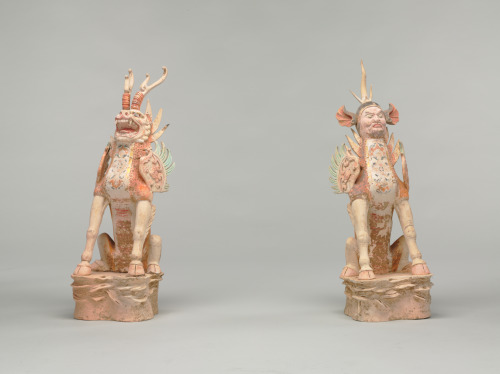
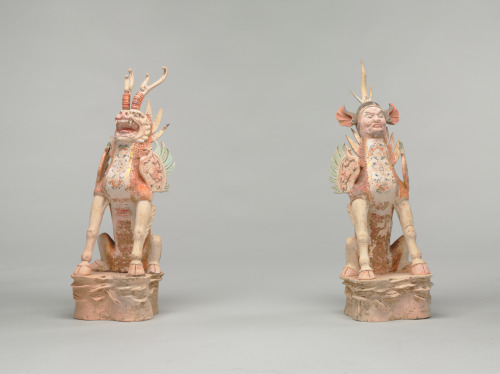
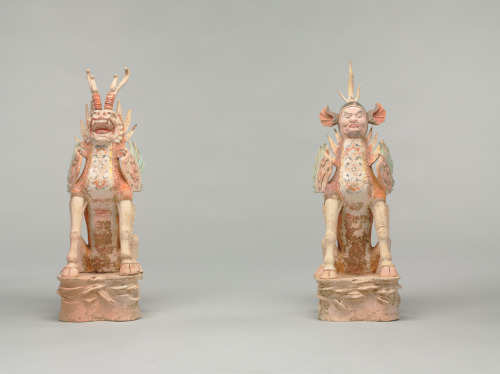
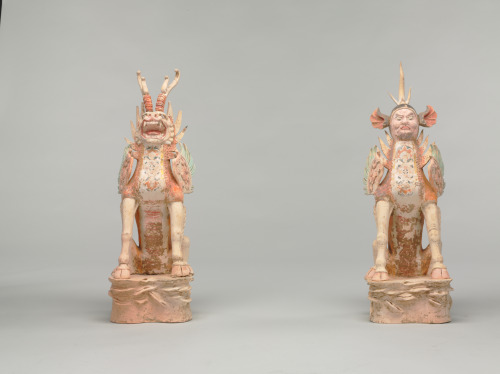
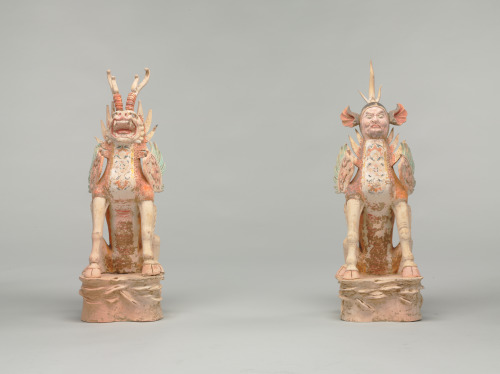
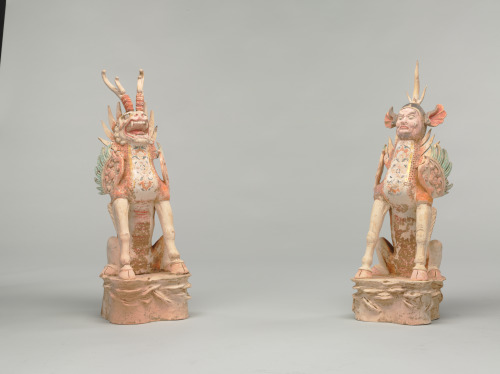
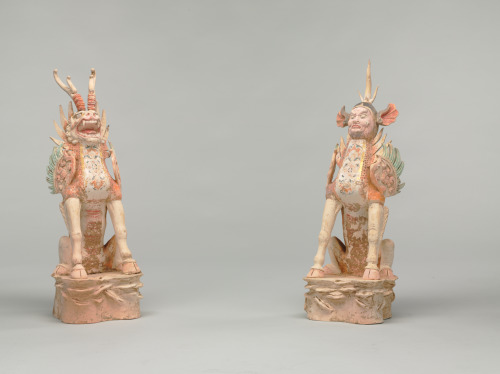
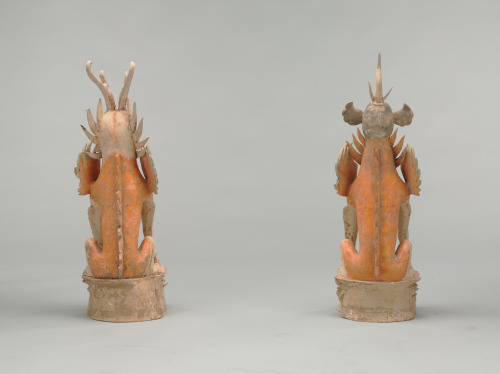
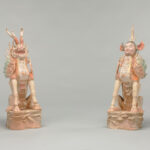
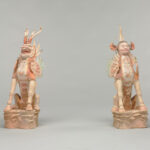
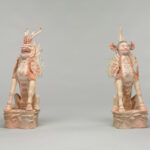
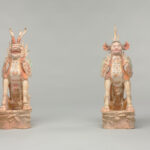
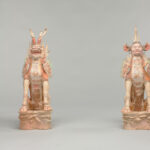
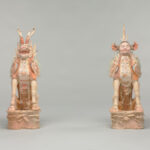
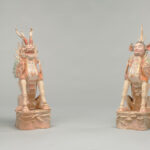
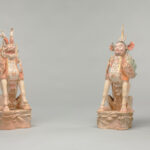
Tomb Guardian with Lion’s Face (Bixie)
667-733
Scroll
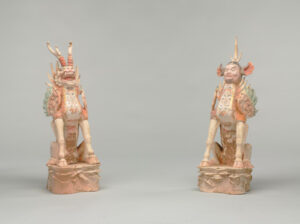
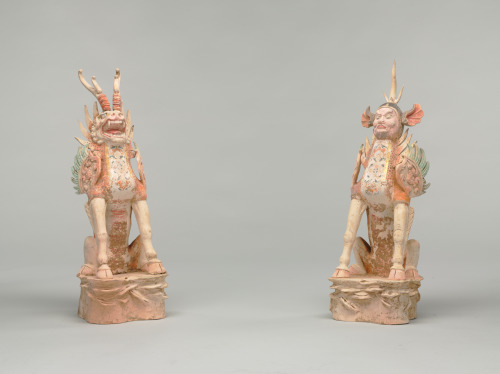
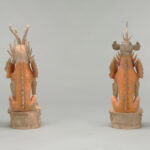
Tomb Guardian with Lion’s Face (Bixie)
667-733
Physical Qualities
White earthenware with unfired pigments, gold leaf, 28 1/8 x 9 7/16 x 11 1/2 in. (71.4 x 24 x 29.2 cm.)
Credit Line
Purchase with exchange funds from Bequest of John M. Glenn, Gift of Alexander B. Griswold, Gift of Mr. and Mrs. L. Manuel Hendler, The Mary Frick Jacobs Collection, Gift of Randolph Mordecai, Gift from the Estate of Ruth Marshall Mugford, and Gift of Elizabeth Remsen; and Julius Levy Memorial Fund
Object Number
1991.119.2
A pair of tomb guardians—one with the face of a human and the other with the head of a lion—guarded the entrance to the tomb of a member of China’s elite. Only two of these paired guardians were needed to protect the tomb. Meng Kang, a 3rd-century historian, named these creatures: “If it has one horn, it may be a tianlu (heavenly deer); if it has two horns, it may be a bixie (one who averts evil).”
Horns, large eyes, wings, serpentine bodies, serrated spines, and hooves often appear on evil-averting creatures. The pairing of these creatures—one with a lion’s mouth opened mid-roar and the other with ears on alert—suggests that fierceness and vigilance were essential to the safety of the departed soul. Guardians were believed to protect the tomb from grave robbers and evil spirits, ensuring the soul of the deceased would rest undisturbed. They also prevented a dissatisfied soul from leaving the tomb to threaten living family members.
The Baltimore Museum of Art by purchase, 1991; J. J. Lally & Co., New York (acquired after 1990)
Asian Reinstallation: Home, Temple, Tomb
Asian Gallery Rotations 2021
[Asian Refresh]
Asian Gallery Rotations 2022
Asian Gallery Rotations 2023
Asian Rotations 2024
Asian Rotations 2025
Baltimore Museum of Art. The Baltimore Museum of Art: Celebrating a Museum. Baltimore: The Baltimore Museum of Art, 2014.
 On View at the BMA