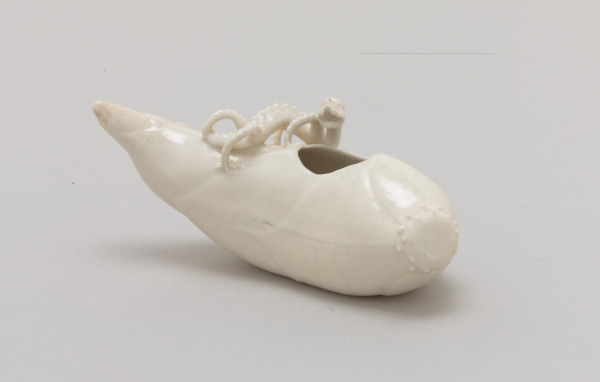
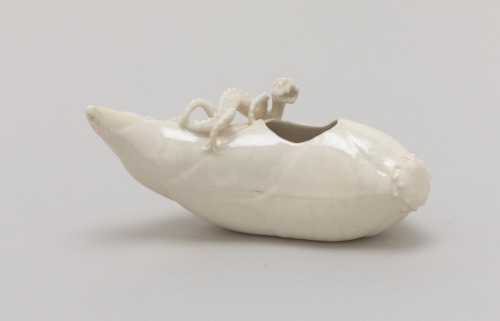
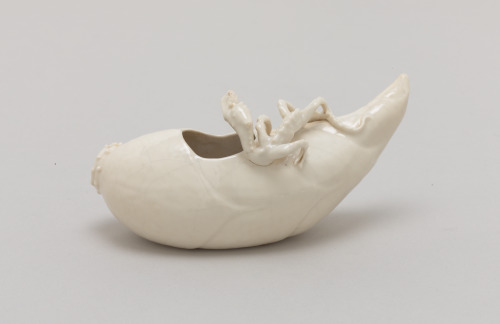
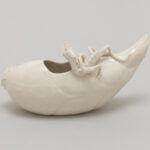
Water Pot in the Form of a Bamboo Shoot
1734-1749
Scroll
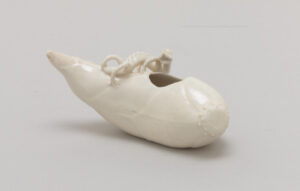
Water Pot in the Form of a Bamboo Shoot
1734-1749
Physical Qualities
'Slippery stone' (huashi) porcelain with white glaze, 2 1/8 x 4 1/2 x 2 1/4 in. (5.4 x 11.4 x 5.7 cm.)
Credit Line
Gift of Lawrason Riggs of J
Object Number
1945.59.33
The brush washer and the waterpot are required for the practice of calligraphy and painting: the brush washer to rinse the brush, and the waterpot to hold fresh water for preparing the ink. Chinese ink, in the form of a solid cake or stick, has to be ground on a stone or slab and dissolved with water to the desired concentration. Paper, brush, ink, and ink stone were called the “Four Perfections.”
The Baltimore Museum of Art by gift, 1945; Lawrason Riggs of J, Baltimore; from his uncle, General Lawrason Riggs, Baltimore (1861-1940)
Asian Reinstallation: Home, Temple, Tomb
Frances Klapthor, Chinese Ceramics, Baltimore: BMA, 1993, no. 109, p. 57.
Baltimore Museum of Art. The Baltimore Museum of Art: Celebrating a Museum. Baltimore: The Baltimore Museum of Art, 2014.
Ming Wilson, "Rare Marks on Chinese Ceramics," Percival David Foundation of Chinese Art and the Victoria and Albert Museum, 11/19/98-5/28/99, no. 43 [for the very similar dragon perched on the flat lid of a bamboo-shaped Ewer and lid, Qianlong Period, soft paste porcelain with white glaze, marked "Beiyanshi zuo (Made by Beiyanshi)".
S. J. Vainker, "Chinese Pottery and Porcelain," NY: George Braziller, Inc., 1991, p. 202.
Rose Kerr, "Chinese Ceramics Porcelain of the Qing Dynasty 1644-1911," London: Victoria and Albert Museum, 1986, pp. 52-53.
S. J. Vainker, "Chinese Pottery and Porcelain," NY: George Braziller, Inc., 1991, p. 202.
Rose Kerr, "Chinese Ceramics Porcelain of the Qing Dynasty 1644-1911," London: Victoria and Albert Museum, 1986, pp. 52-53.