Female Ancestor Mask (Ngaady Mwaash)
Looking at a Special Color
0:00
/
1:04
A Conversation About Materials with Former BMA Conservator Louise Wheatley
0:00
/
0:58
Female Ancestor Mask (Ngaady Mwaash)
Unidentified Kuba Artist
Date:
Late 19th–Early 20th Century
Medium:
Wood, cloth, copper alloy tacks, plant fibers, cowrie shells, glass beads, and paint
Size:
Depth: 11 13/16″
Width: 9 1/16″
Height: 13 1/2″
Cowrie shells, long a symbol of wealth and status in the Kuba Kingdom, mark the masks most closely associated with the royal court. Three such artworks—Mukenga, Ngaady Mwaash, and Bwoom—are shown on this platform. Every year, in almost every community, these three masks are worn by dancers who dramatize the mythic origin stories of the kingdom. In these masquerades, Woot (Mukenga), the mythical founder of Kuba, successfully fights a commoner (Bwoom) to win the affection of Mweel (Ngaady Mwaash), a woman who becomes his wife.
Founded in 1625, the Kuba Kingdom is a multi-ethnic society in which power was historically concentrated in the hands of one ethnic group: the Bushoong. The Bushoong claim descent from Woot and Mweel, and the Kuba royal court has long promoted the widespread use of these masks throughout the kingdom as a savvy political strategy to promote Bushoong supremacy.
Gift of Alan Wurtzburger BMA 1954.145.77
 1:09
1:09
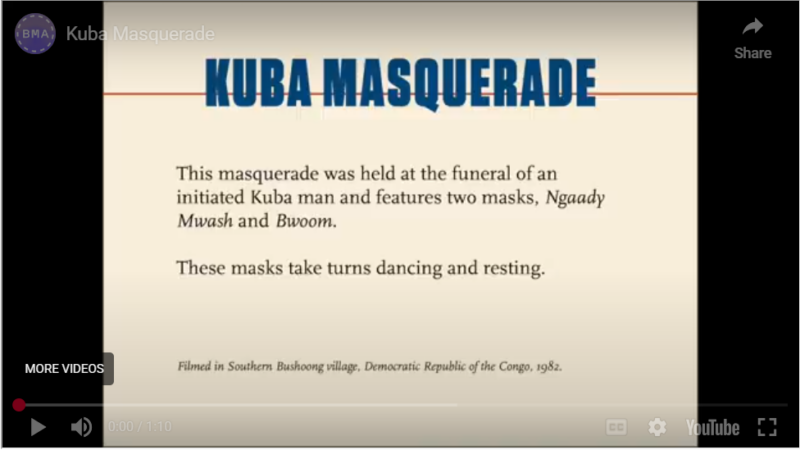
Kuba Masquerade
This masquerade was held at the funeral of an initiated Kuba man and features two masks, Ngaady Mwash and Bwoom. These masks take turns dancing and resting. Filmed by David Binkley in Southern Bushoong village, the Democratic Republic of the Congo, 1982. Used with permission.