La Vachère
0:00
/
2:28
Theodore Robinson
Date:
1888
Medium:
Oil on canvas
Size:
Width: 59″
Height: 85 1/2″
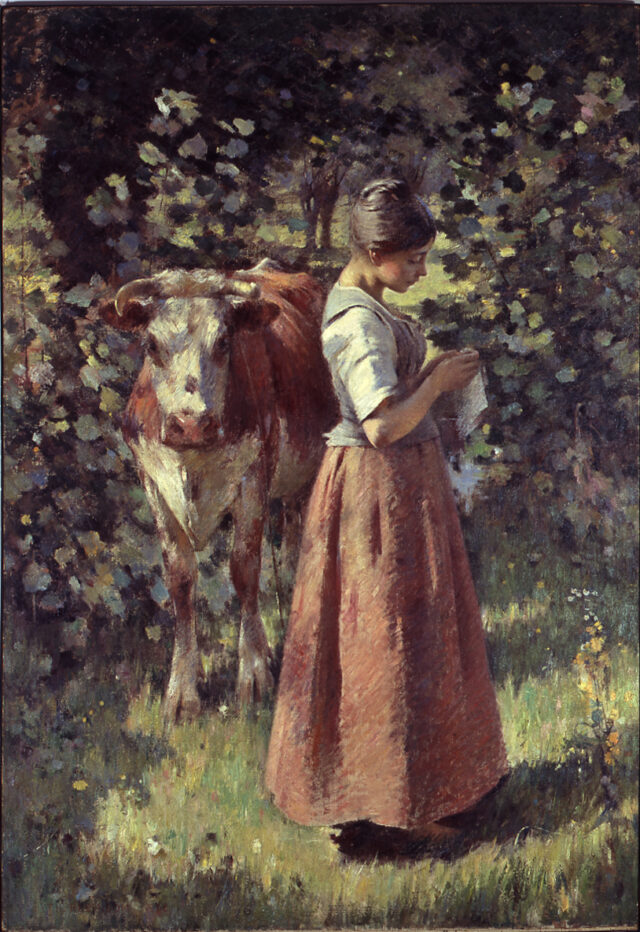
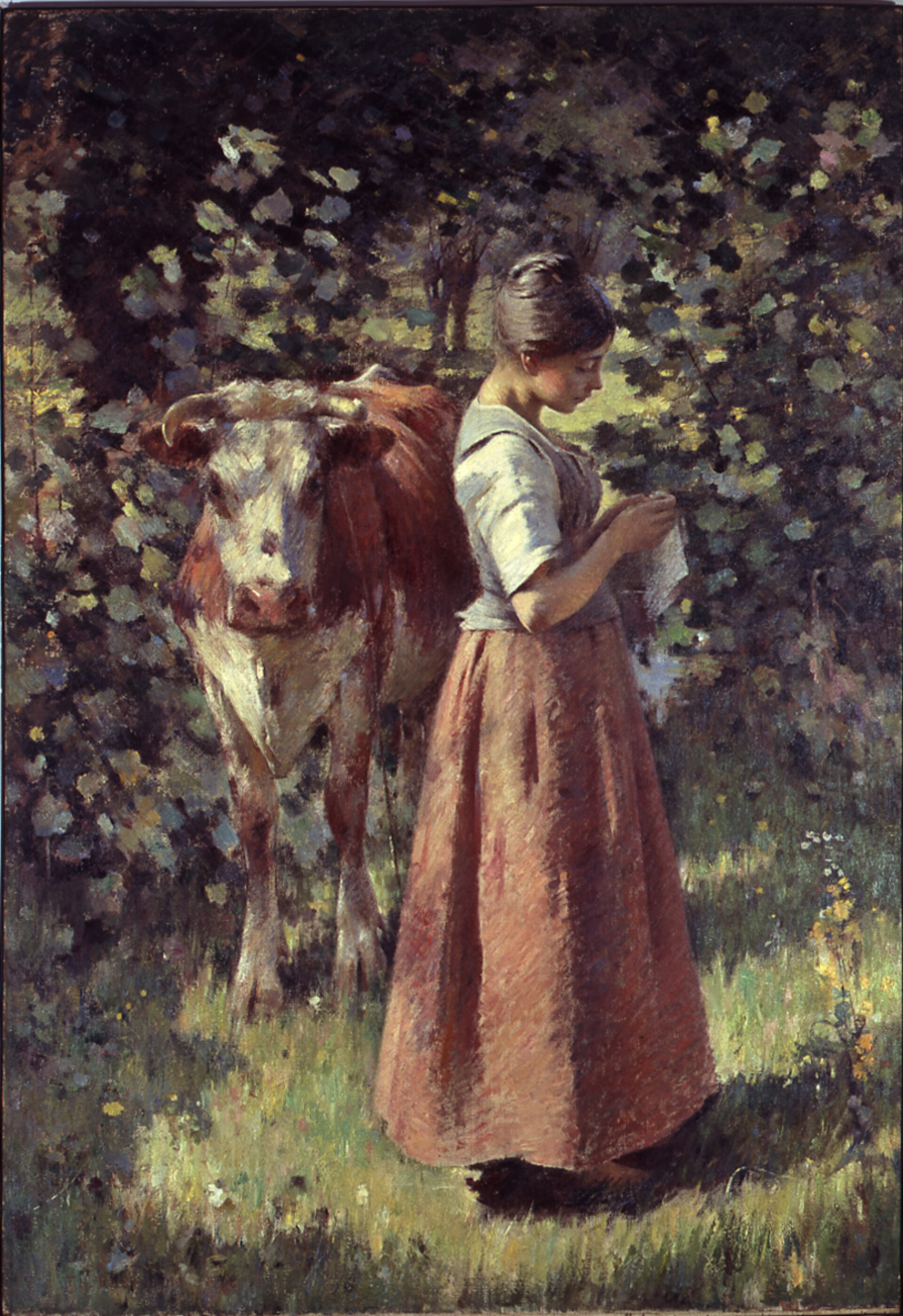
Painted in the summer of 1888, La Vachère depicts a young peasant girl occupied with sewing while tending her cow. A soft, light palette and varied brushstrokes demonstrate Theodore Robinson’s familiarity with elements of Impressionism as practiced by his friend Claude Monet. Robinson worked with Monet during the summers of 1888–1892. Here, the trees shimmer in reflected light while colorful shadows play across the fabric of the young girl’s costume. Shown in the Paris Salon in 1889, this full-scale canvas was preceded by numerous studies. One of those studies, In the Grove [#6, to the right], was donated to the Museum in 1950 as part of the Cone Collection. Sixteen years later, the BMA acquired La Vachère.
Visual Description:
This oil on canvas painting measures seven feet high and five feet wide. It depicts a young adult figure, who appears to be female, standing in profile in a grassy area. Her back is lit by the sun and her face is partially in shadow. She is wearing a long brown skirt and a white blouse under a gray bodice with her brown hair tied up in a high bun. She is looking down at her hands, which she holds at chest height, and seems to be knitting or sewing. Behind her stands a cow with a white–and–brown coat, looking directly at the viewer. Both figures stand in front of what appears to be dense foliage, creating a pastoral scene.
Given in Memory of Joseph Katz by His Children BMA 1966.46
Additional Audio
A Conversation about Light and Cows
Transcript
[Aaron Henkin] Hi. Aaron Henkin here from Public Radio Station, WYPR, standing in front of this gigantic
painting with Katy Rothkopf, who is senior curator of European painting and sculpture. This is a beautiful
piece, but the first thing you notice about it is it’s huge.
[Katy Rothkopf] Yes. This painting was made by Theodore Robinson for the annual Salon in Paris, which
was a showcase for artists where the bigger your painting was, the better chances you have for someone
noticing you.
[Aaron Henkin] So one of the joys looking at a painting this big is that you can really zoom in. Is there any
particular area in this painting that really fascinates you?
[Katy Rothkopf] Just behind the female figure, there’s a clearing and the sun comes out, and she’s really
framed by the foliage around her. His technique is so delicate and so powerful. I find it a picture that I could
look at forever,
[Aaron Henkin] And yet somehow you are riveted to the cow’s slightly hostile gaze.
[Katy Rothkopf] Yeah. The cow is looking right at the viewer, which is a bit unusual. I think for Robinson, it
provided a real focal point. It also allows him to showcase his skill as a portrait painter, both portraits of
animal and human, but you really also get that sense of light and atmosphere and color that was so typical
of the Impressionist style.
Theodore Robinson with Claude Monet in France
Transcript
[Katy Rothkopf] Robinson was someone who had a relatively traditional academic painting background.
This picture was made while he was living in France in Giverny, a town where someone very famous lived at
the time, Claude Monet, who was one of the most important Impressionist painters of the day. And I think
for Robinson being close to Monet really provided him with an opportunity to learn and to see the nature
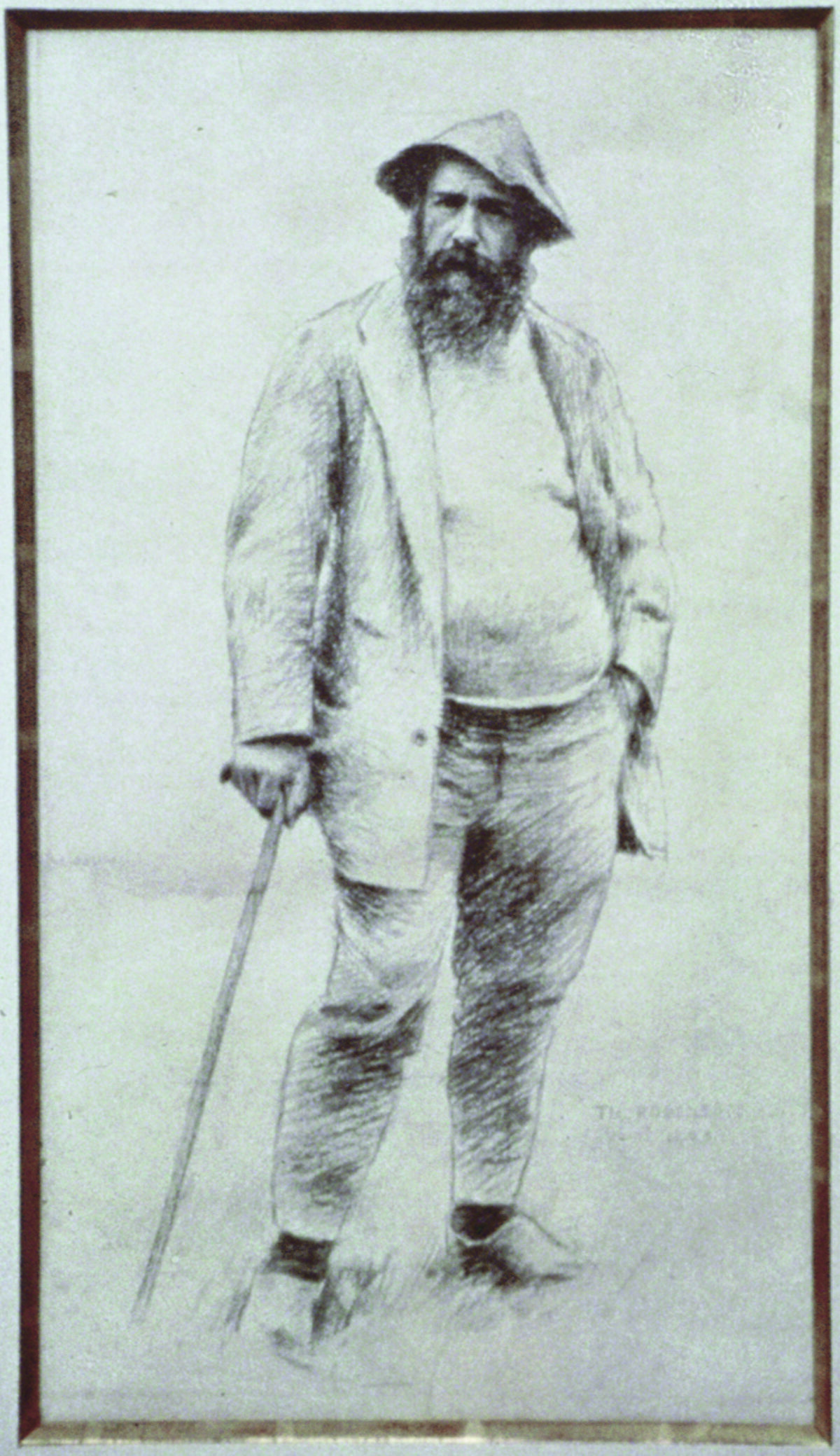
that Monet saw through his own eyes. And in fact, Robinson even made a very lovely drawing of Monet
during their friendship.
[Aaron Hankin] Let me read to you what Robinson wrote about Monet in 1892. It seems to relate to
Robinson’s painting as well as Monet’s. He wrote, There is more color in nature than the average observer is
aware of. I believe anyone not colorblind can prove this for himself by taking the time and trouble to look for
it.