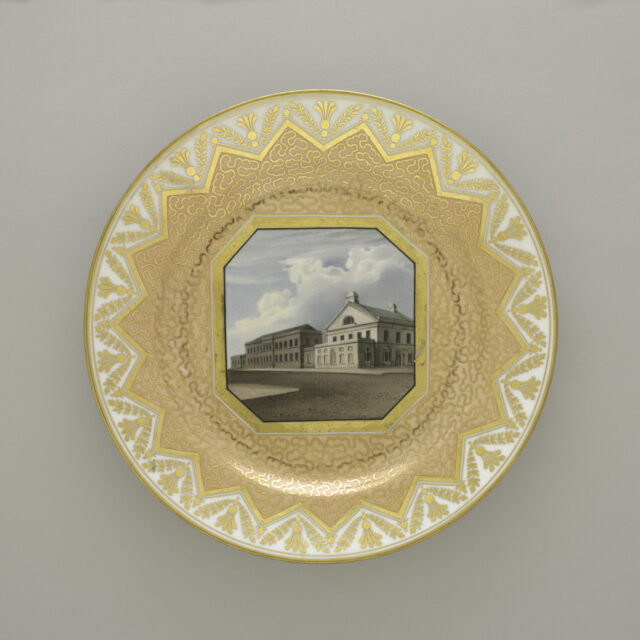
Plate: Tintern Abbey
A Bucolic Table Setting
0:00
/
00:54
Related to a Poem
0:00
/
0:53
Manufacturer: Chamberlain’s
Date:
1818
Medium:
Soft-paste porcelain, painted with overglaze enamels and gold; salmon ground with gilt vermiculation
Size:
Height: 1 1/4″
Diameter: 8 9/16″
Each service was made for the family of the extraordinarily wealthy Baltimore investment banker Alexander Brown. Brown’s eldest son, William, was managing a trading firm in Liverpool, England, in 1816, when he commissioned the elaborate English dessert set decorated with picturesque views and stirring scenes of the hunt.
Like little paintings, the individual entries are consistently “framed” by an elaborate border made up of salmon-colored ground with gilt vermiculation (a dense pattern of sinuous lines recalling worm tracks). William Brown ordered two dozen additional plates in 1818.
Sometime between 1800 and 1815, Alexander Brown’s third son, John, ordered an enormous dinner service of Paris porcelain decorated with neoclassical figures and trophies executed in black enamel, then highlighted with gold and set against a peach or gray border. A patriotic American flag with 13 stars adorns the center of each plate. The set originally included more than 100 objects, including plates, bowls, and serving pieces.
The rich ornamentation of these porcelains served to promote prosperity and a shared cultural heritage. Themes and motifs drawn from the classical past may have stimulated table conversation, as would decorations touching on American patriotism or scenes recalling foreign locales. While we do not know if the two services were ever actually used in the same household, we can see that the salmon-colored border on the English dessert service harmonizes with the peach borders on pieces from the large French dinner service. Both sets once belonged to Baltimore collector Frances Whitem, one of the founding trustees of the Baltimore Museum of Art.
Gift of Mrs. Francis White, From the Collection of Mrs. Miles White, Jr. BMA 1973.76.172.9