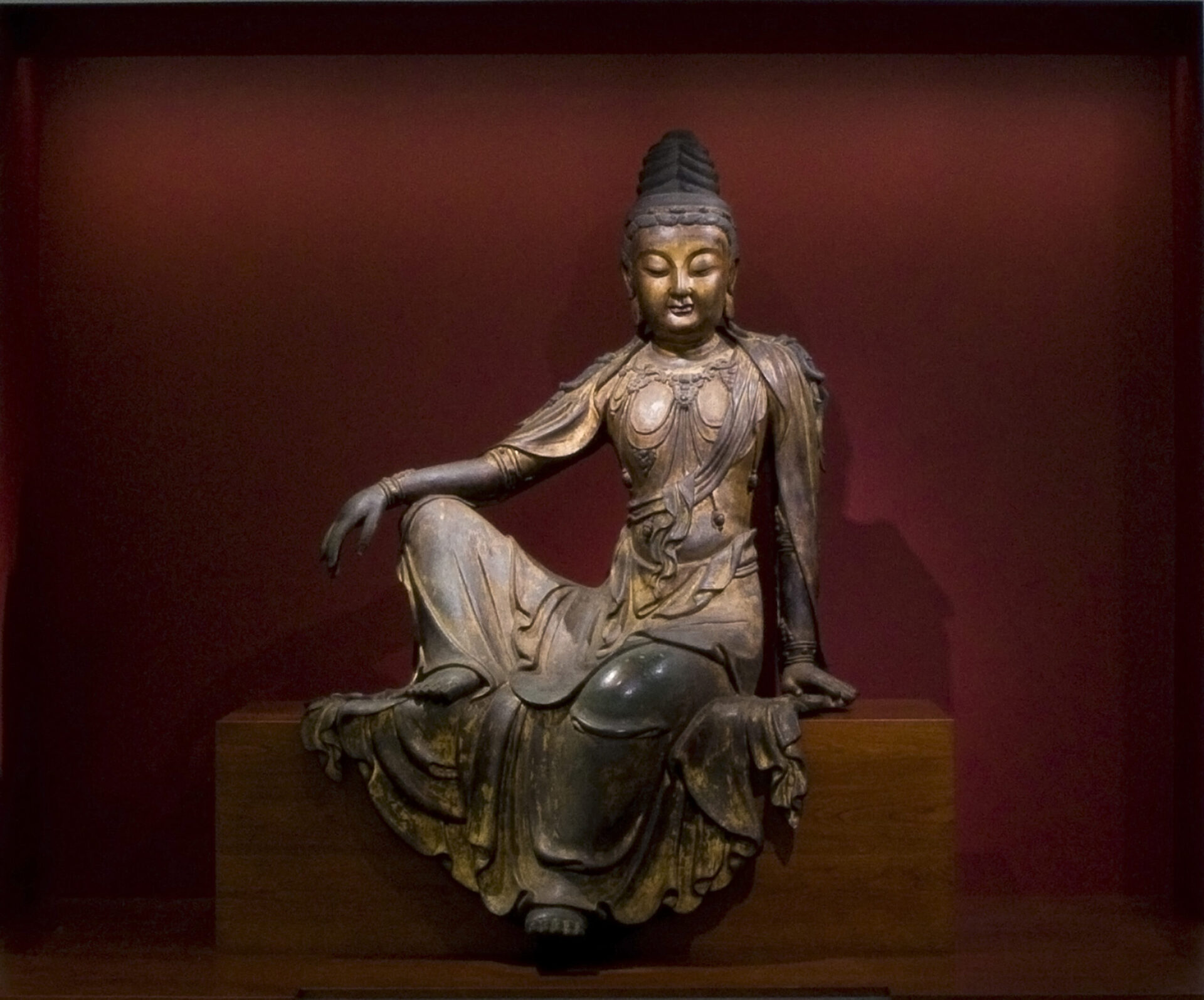
A life-size seated statue of a Boddhisatva figure in a relaxed pose, with one arm resting on its knee and its clothing draped over the edge of a platform. The figure is adorned in many necklaces and bracelets.

Water-Moon Guanyin (Shuiyue Guanyin)

0:00 / 2:41

Ming Dynasty (1368–1644)
Date:
15th Century
Medium:
Metal alloy, originally gilded, with blue and red pigment
Size:
Depth: 33″
Width: 41″
Height: 61 3/4″

Guanyin attained enlightenment with the guidance of the Amitabha Buddha, the Buddha of Infinite Light, but rather than enter the eternal bliss of nirvana, she remains in this world to relieve the suffering of all creatures. Able to assume many guises, she is portrayed here as Water-Moon Guanyin, known to sit in a rocky grotto at the water’s edge beneath the full moon. She contemplates the moon’s ephemeral reflection at her feet. Strands of beaded jewelry, flowing robes, long fleshy earlobes, long hair, and bare feet are familiar attributes of Guanyin. Her slight smile invites the confidence of the faithful, while her downcast eyes survey the emptiness of existence.

Within a larger temple complex, this Water-Moon Guanyin would have occupied a north-facing altar behind the Buddha altar, in a passage hall with both a front and rear door. There, faithful followers venerated Water-Moon Guanyin by walking in a circle around the back-to-back altars in an effort to be reborn in Amitabha’s Western Paradise. Credited with providing children, easing childbirth, restoring health, and averting natural disasters, Guanyin’s popularity remains second only to Buddha’s across most of Asia.

Julius Levy Memorial Fund BMA 1944.80

Additional Audio

Bejeweled Being

Transcript

[Frances Klapthor] This is the figure of the Bodhisattva Guanyin. A Bodhisattva is a being who has attained enlightenment and can therefore leave the world and enter Nirvana. But Guanyin instead has chosen to remain here in the world to help all sentient beings in their struggle to escape unceasing existence in the world of pain.Unlike the Buddha, who appears with short hair and unadorned, this figure has long, elaborate hair and strands of pearl jewelry and gold bracelets and arm cuffs. These signify that Guanyin remains in this world, whereas for the Buddha who has escaped this world, he’s stripped of all jewelry and he’s shorn his hair.
Guanyin became especially popular in the decades as a miracle worker, and so newspapers of the Ming Dynasty, the period of the statue, would publish tales of her assistance to people in averting floods, for example, or plagues of locusts. And she was always prayed to for the birth of sons.

Visual Description

This life-sized seated statue of the bodhisattva Guanyin, made using bronze-colored metal alloy, is approximately five feet high, three and a half feet wide, and two and three-quarters feet deep. Guanyin, who here appears female, smiles serenely and casually poses with her right arm propped up on her bent right knee while leaning on her left arm, which rests on the platform she sits on. Guanyin wears intricate, flowing robes and many layered necklaces and bracelets.

Gender Ambiguity in This Sculpture

Transcript

[Marta Hanson] This is a really very interesting statue from the 15th century because you can see the gender ambiguity.
[Aaron Henkin] That’s Marta Hanson, who teaches the history of Chinese medicine at Johns Hopkins Medical School. She explains that this Chinese Bodhisattva of compassion started out in Indian Buddhism as male.
[Marta Hanson] But in the Chinese case, the value of compassion was gendered female. She’s wearing a chest of jewelry. Now, this you might think is very feminine to have such rich jewelry, but in fact her chest is rather flat and a rather strong, robust, athletic masculine figure. You see a very graceful right hand over the right knee and graceful curves of the gown that she’s wearing. But at the same time, you see the foot exposed on her. At this time in the 15th century it would’ve been quite shocking to have a female with bare feet and rather thick feet, especially at a time when they were binding their feet. So there’s a very clear sense that there’s male and female aspects to it.

Looking at Materials

Transcript

Aaron Henkin] This statue is made from cast bronze, which was then painted.
[Marta Hanson] We have actual traces of red pigment on her lips while there’s some blue pigment that still remains on the hair, so clearly in her original form, she would’ve been quite colorful. You might be surprised about how much she weighs. Think about it. How much do you think she weighs? Consider her size. She’s made in bronze. She’s quite imposing. Well, in fact, she weighs over a thousand pounds.