Samuel Williamson and George Washington Riggs
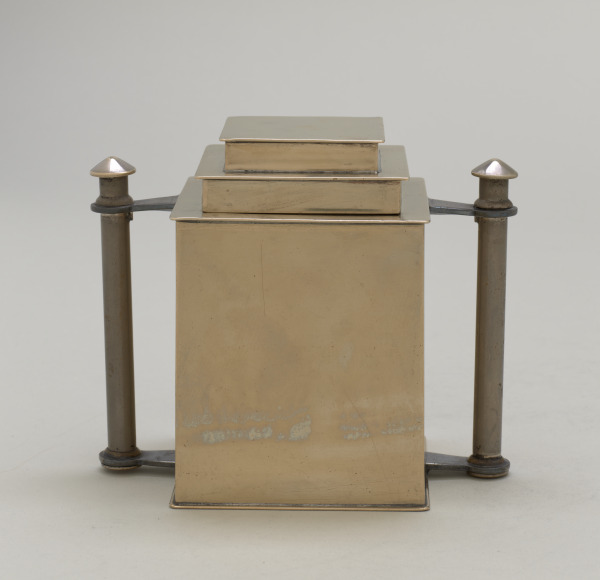
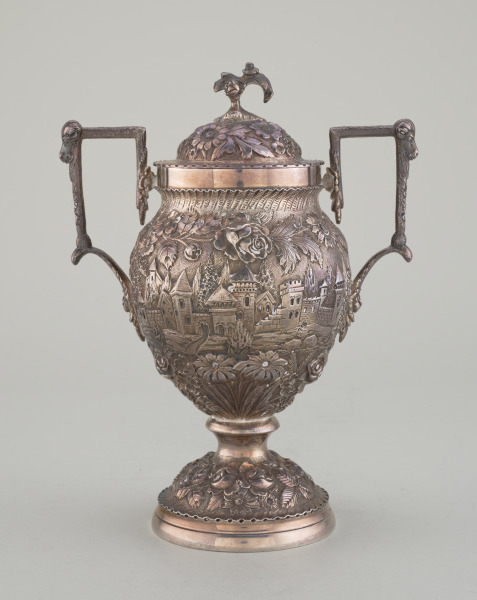
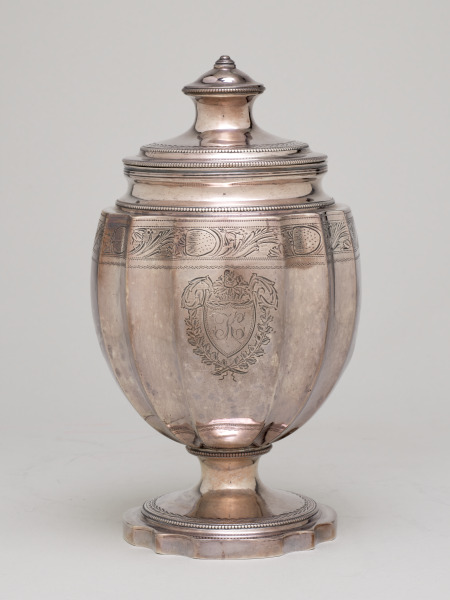
Covered Sugar Bowl
1804-1814
Scroll
Physical Qualities
Silver, 7 3/4 × 7 3/4 × 3 3/4 in. (19.7 × 19.7 × 9.5 cm.)
Credit Line
Gift of Mrs. Harrison Gardner, Wenham, Massachusetts
Object Number
1985.102.4
Working at approximately the same time - one in Philadelphia, the other in Baltimore - a couple of talented silversmiths produced the two monumental tea and coffee services now displayed here. Their similarities and differences offer a glimpse of consumer taste in Baltimore during the early 19th century.
The austere Philadelphia set features squared-off forms with angular silver handles insulated with ivory stops. Each vessel bears discreet bands of gadrooned ornament. An elegant, if now un-deciphered monogram has been engraved on each piece. Cast rectangular finials on lids repeat each shape which stands on a stepped, rectangular foot. The set was made by Samuel Williamson. He conducted a thriving business as a Philadelphia silversmith between 1800 and 1813 or 1814, when he moved to a farm in Chester County, Pennsylvania. Williamson did not mark the service, but his ledger book for 1810 to 1813 records transactions with George W. Riggs of Baltimore. Riggs, who retailed this set, stamped his mark on the underside of each piece. As Riggs moved to Baltimore in around 1810, we can date this service between his arrival in Baltimore and Williamson's move to the farm.
Considerably more organic in form and elaborate in decoration, the melon-shaped pieces actually made in Baltimore are proudly stamped "C L Boehme Sterling" on the edges of each curvaceous foot--where users could see it. Rich bright-cut ornament includes the initial W enclosed in a wreath and borders with flower baskets as well as repeating with flower baskets as well as repeating floral and geometric bands. The cast finals are ovoid lidded urns. Like the ivory stops on the Philadelphia set, the cheaper wood handles on the Baltimore service did not conduct heat.
If the Baltimore service is more ostentatiously ornamented than the Philadelphia-made set, they share an exaggerated scale. Made at a time when sugar, tea, and coffee were precious commodities, each set is so large that the display of wealth and social position seems to take precedence over the serving of delicate refreshment-although each set give evidence of having been used. Filled with liquid, the largest pot alone weighs five lbs. The pouring out of afternoon tea would have required a strong wrist.
Baltimore Museum of Art by gift,1985; Eloise Lawrence Gardner (1908-1988), Wenham, MA by gift, 1985; Virginia Duval Gardner Wall (1905-1999), New York, NY likely by descent, 1979; Harrison (1901-1979) and Eloise L. Gardner (1908-1988), likely by descent; Philip (1871-1957) and Virginia Rebecca Atkinson Gardner (1874-1951) (m. 1899), Boston, MA likely by descent; Isaac Edmondson (1846-1906) and Viginia Duval Atkinson (1846-1908), Baltimore, MD likely by descent; James Edmondson (1808-1851) and Hannah Ann Smith Atkinson (1821-1899) (m. 1844), Baltimore, MD likely by descent; Thomas Marsh Smith, Baltimore, MD likely by gift; Matthew (1799-1865) and Catherine Marsh Smith (1790-1870), Baltimore, MD likely by commission
AMW Reinstallation 2014
American Wing Rotations 2020
American Wing Rotations 2021
American Wing Rotations 2022
American Wing Rotations 2023
American Wing Rotations 2024
American Wing Rotations 2025
Beasley, Ellen. "Samuel Williamson, Philadelphia Silversmith, 1794-1813." M.A. Thesis, University of Delaware, 1964, p. 41, 45.
Goldsborough, Jennifer Faulds. "Eighteenth and Nineteenth Century Maryland Silver in the Collection of the Baltimore Museum of Art," Baltimore Museum of Art, 1975, pp. 126-127, figs. 149-150. (example of nearly identical teapot and covered sugar bowl, made by Riggs 1935.28.1-2 )
Goldsborough, Jennifer Faulds. "Eighteenth and Nineteenth Century Maryland Silver in the Collection of the Baltimore Museum of Art," Baltimore Museum of Art, 1975, pp. 126-127, figs. 149-150. (example of nearly identical teapot and covered sugar bowl, made by Riggs 1935.28.1-2 )
Inscribed: "TMS" engraved monogram
Markings: Retailer's mark stamped on bottom of base: "RIGGS"
 On View at the BMA