Attributed to Kate Mattingly Edwards
Crazy Quilt
1880-1887
Scroll
Attributed to Kate Mattingly Edwards
Crazy Quilt
1880-1887
Physical Qualities
Silk, including velvet, ribbons, and Stevengraph; silk embroidery threads, cotton lining
, 68 1/4 x 67 in. (173.4 x 170.2 cm.)
Credit Line
Gift of Mrs. A. Taylor Bragonier
Object Number
1956.201
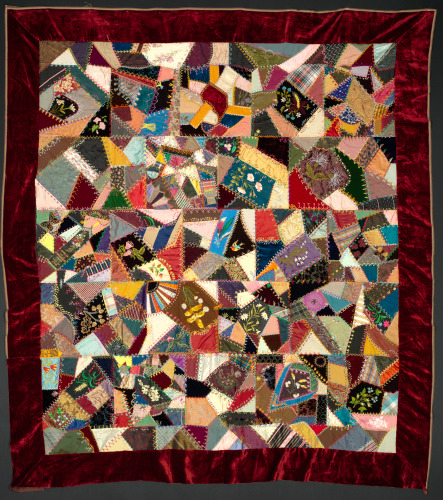
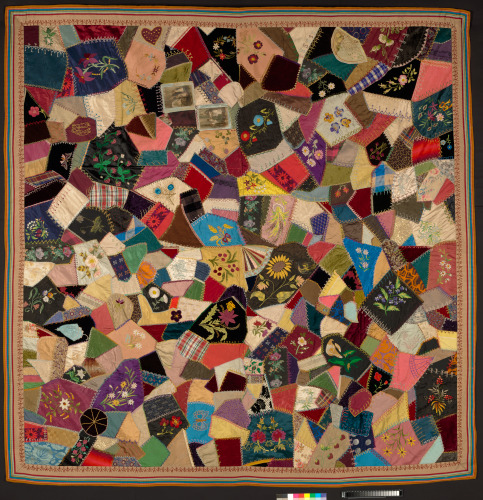
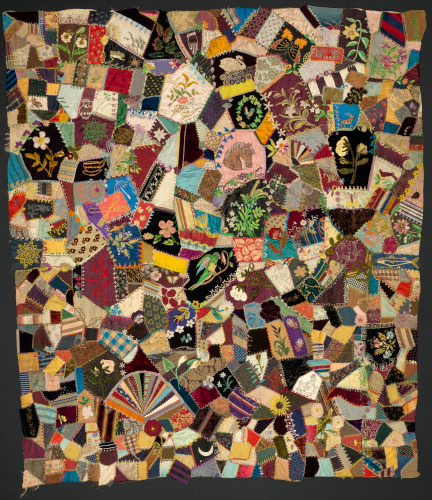
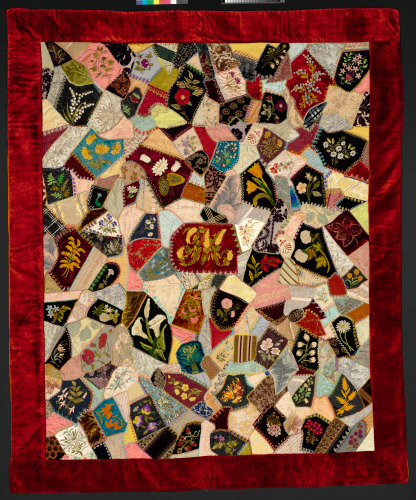
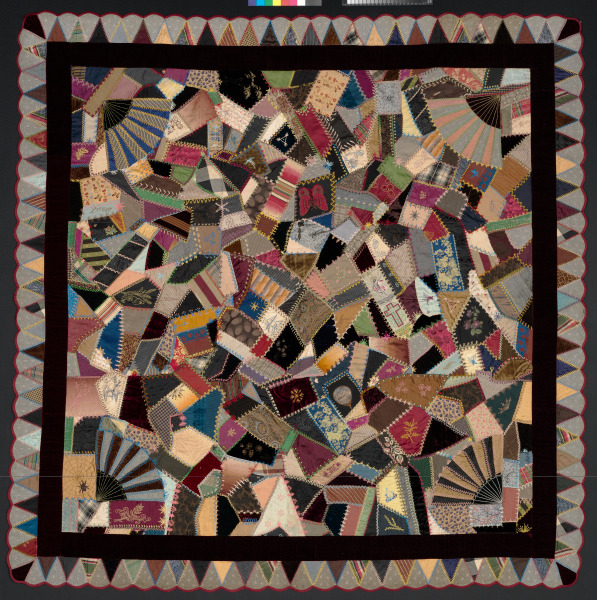
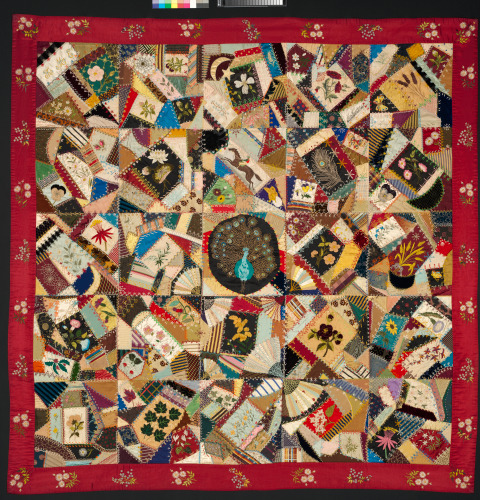
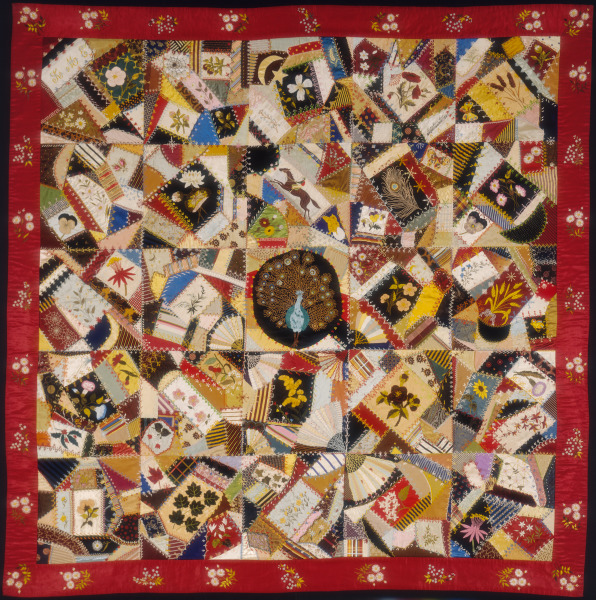
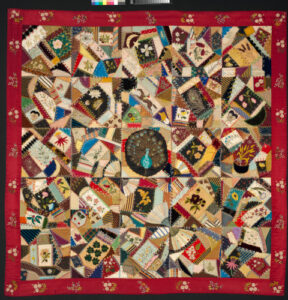
The dramatic embroidered peacock commanding the center of this quilt was a popular symbol of beauty often associated with the Aesthetic Movement of the late 19th century. The exquisite needlework throughout offers a full vocabulary of Aesthetic decorative motifs, including a peacock feather, fans, cattails, musical staffs, spiders and webs, a crescent moon and star, lilies, poppies, and sunflowers. Piecing in this example is asymmetrical, but is contained within a block structure. In most crazy quilts the expensive fabrics on top were attached to a foundation of less expensive material. The seams between fabric swatches and blocks were covered with decorative stitches, which are particularly impressive in this example for their variety and color. Though skillfully rendered, these designs were not necessarily original. Ladies’ magazines and pamphlets featured patterns and transfer designs for both fancy stitches and pictorial motifs as well as prepackaged kits for crazy patchwork blocks.
By the 1880s, sophisticated women had rejected traditional calico and wool quilts of geometric design as "hopelessly old-fashioned." Through their crazy quilts they experimented with new styles and ideas in embroidery and the household arts inspired by the Aesthetic Movement in England and the 1876 Centennial Exhibition in Philadelphia. The making of a crazy quilt provided an opportunity to produce an article for the home that was truly "artistic," and therefore, according to the prevailing philosophy, morally and spiritually uplifting.
The dramatic peacock embroidered in the center of this quilt was a popular symbol of beauty in Aesthetic art. The exquisite needlework throughout offers a full vocabulary of decorative motifs including a peacock feather, fans, cat-o-nine tails, musical staffs, spiders and webs, a crescent moon and star, lilies, poppies, and a multitude of other flowers. The seams between the irregular swatches of fabric contained within the 25 crazy patchwork blocks are covered with an amazing array of decorative stitches. Though artistic, these designs were not necessarily original. Ladies' magazines and pamphlets featured patterns and transfer designs for both fancy stitches and pictorial motifs and commercial companies sold prepackaged kits for crazy blocks.
The dramatic embroidered peacock commanding the center of this quilt was a popular symbol of beauty often associated with the Aesthetic Movement of the late 19th century. The exquisite needlework throughout offers a full vocabulary of Aesthetic decorative motifs, including a peacock feather, fans, cattails, musical staffs, spiders and webs, a crescent moon and star, lilies, poppies, and sunflowers. Piecing in this example is asymmetrical, but is contained within a block structure. In most crazy quilts the expensive fabrics on top were attached to a foundation of less expensive material. The seams between fabric swatches and blocks were covered with decorative stitches, which are particularly impressive in this example for their variety and color. Though skillfully rendered, these designs were not necessarily original. Ladies’ magazines and pamphlets featured patterns and transfer designs for both fancy stitches and pictorial motifs as well as prepackaged kits for crazy patchwork blocks.
Prominently displayed in this quilt is a Stevengraph (a picture woven in silk) of “Iroquois,” a horse that won two legs of the British triple crown, including the Epsom Derby in 1881. His presence on an American quilt may be explained by the fact that Iroquois was American born and bred.
The Baltimore Museum of Art by gift, 1956; Dorothy Belt Berry Bragonier (Mrs. A. Taylor Bragonier)(1894-1985) by inheritance; Kate Mattingly Edwards (1857-1954) (later Mrs. H.C. Berry).
American Crazy Quilts
McMorris,Penny. Crazy Quilts, N.Y.: E.P. Dutton, 1984, especially p. 39, p. 40, p. 54, p. 58. p. 69, pp. 92-94.
Brick, Cindy. Crazy Quilts:History, Techniques, Embroidery Motifs. Minneapolis: Voyageur Press, 2008.
Peck, Amelia, American Quilts & Coverlets in The Metropolitan Museum of Art, N.Y.: The Metropolitan Museum of Art and Dutton Studio Books, 1990, pp. 94-97,
p. 191, p. 208.
Safford, Carleton L. and Robert Bishop, America's Quilts and Coverlets, N.Y.: E. P. Dutton & Co., Inc., 1972, pp. 296-303.
Houck, Carter, The Quilt Encyclopedia Illustrated, N.Y.: Harry N. Abrams, Inc., 1991,
pp. 179-178.
Gunn, Virginia, 'Crazy Quilts and Outline Quilts: Popular Responses to the Decorative Art/Art Needlework Movement, 1876-1893,' Uncoverings 1984, Ed. Sally Garoutte, Mill Valley, CA: American Quilt Study Group, 1985, pp. 131-152.
Godden, Geoffrey A.. Stevengraphs and other Victorian Silk Pictures, London: Barrie & Jenkins, 1971,pp. 154-155, pls. 114 and 114a, cat. 34, 34a, and 34b.
Brick, Cindy. Crazy Quilts:History, Techniques, Embroidery Motifs. Minneapolis: Voyageur Press, 2008.
Peck, Amelia, American Quilts & Coverlets in The Metropolitan Museum of Art, N.Y.: The Metropolitan Museum of Art and Dutton Studio Books, 1990, pp. 94-97,
p. 191, p. 208.
Safford, Carleton L. and Robert Bishop, America's Quilts and Coverlets, N.Y.: E. P. Dutton & Co., Inc., 1972, pp. 296-303.
Houck, Carter, The Quilt Encyclopedia Illustrated, N.Y.: Harry N. Abrams, Inc., 1991,
pp. 179-178.
Gunn, Virginia, 'Crazy Quilts and Outline Quilts: Popular Responses to the Decorative Art/Art Needlework Movement, 1876-1893,' Uncoverings 1984, Ed. Sally Garoutte, Mill Valley, CA: American Quilt Study Group, 1985, pp. 131-152.
Godden, Geoffrey A.. Stevengraphs and other Victorian Silk Pictures, London: Barrie & Jenkins, 1971,pp. 154-155, pls. 114 and 114a, cat. 34, 34a, and 34b.
Inscribed: Embroidered in upper left corner: 'K M E'
Maker
Attributed to Kate Mattingly Edwards
1856–1953
American, 1857-1954, active West Virginia
Meet Attributed →
Explore the Collection Further