
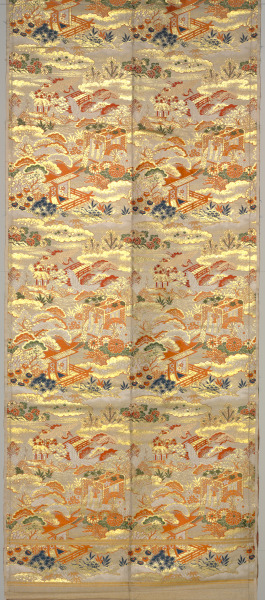
Tankuma Company
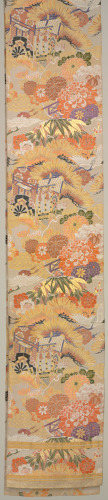
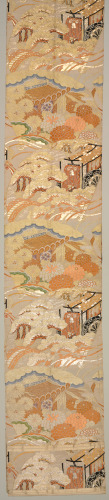
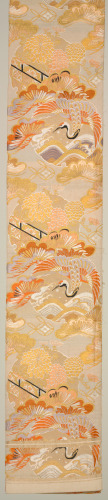
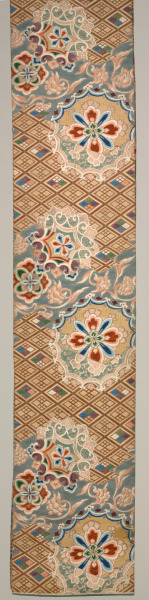
Dismantled Maru Obi with Gosho-guruma (Noble’s Carriage) and Palace Veranda
1911-1939
Scroll
Tankuma Company
Dismantled Maru Obi with Gosho-guruma (Noble’s Carriage) and Palace Veranda
1911-1939
Physical Qualities
Silk with supplementary wefts of silk, metal-leafed paper strips, and metal-leafed paper strips wrapped around a silk or cotton thread core, 160 x 27 in. (406.4 x 68.6 cm.)
Credit Line
Gift of Clara Jane Shaull, Monkton, Maryland, from the Collection of Robert S. Shaull
Object Number
1990.302
(Anita Jones and Ann Marie Moeller, The Baltimore Museum of Art, Baltimore, MD, "Kimono and Obi: Romantic Echoes from Japan's Golden Age," July 10, 2016 - January 15, 2017. Wall label text.)
Dismantled Maru Obi with Gosho-guruma
(Noble’s Carriage) and Veranda of Heian Palace
1912–1940, Taisho/Early Showa Eras
Japan
Silk with supplementary wefts of silk, metal-leafed
paper strips, and metal-leafed paper strips wrapped
around a silk or cotton thread core
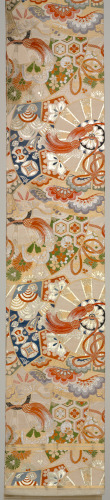
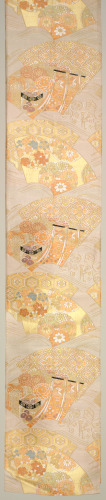
A noble’s carriage (gosho-guruma) and the corner veranda of a palace with an exposed kicho (portable curtain of state) are prominent Heian motifs on this fabric that was once a maru obi (a very formal kimono sash). Maru obi are commonly made of a complex woven fabric called nishiki that was folded down the middle along its length and sewn. Nishiki is a Japanese term embracing many weaving techniques, all of which produce cloth woven with colorful threads. This obi has been dismantled, thus revealing the reverse of the fabric with seven colors of supplementary silk wefts (horizontal threads). Additional wefts of flat gold-colored metal-leafed paper cut in strips and wefts of metal-leafed paper strips wrapped around a silk or cotton thread core are also present. It took a master weaver to manipulate these flat and round threads into this stunning and costly fabric.
Gift of Clara Jane Shaull, Monkton, Maryland,
from the collection of Robert S. Shaull, BMA 1990.302
A noble’s carriage (gosho-guruma) and the corner veranda of a palace with an exposed kicho (portable curtain of state) are prominent Heian motifs on this fabric that was once a maru obi (a very formal kimono sash). Maru obi are commonly made of a complex woven fabric called nishiki that was folded down the middle along its length and sewn. Nishiki is a Japanese term embracing many weaving techniques, all of which produce cloth woven with colorful threads. This obi has been dismantled, thus revealing the reverse of the fabric with seven colors of supplementary silk wefts (horizontal threads). Additional wefts of flat gold-colored metal-leafed paper cut in strips and wefts of metal-leafed paper strips wrapped around a silk or cotton thread core are also present. It took a master weaver to manipulate these flat and round threads into this stunning and costly fabric.
The Baltimore Museum of Art by gift 1990, Clara Jane Shaull, ex. collection Robert S. Shaull, (husband) by purchase in Manchuria.
Kimono and Obi: Romantic Echoes from Japan's Golden Age
Yang, Sunny and Narasin, Rochelle M. Textile Art of Japan. Tokyo: Shufunotomo/ Japan Publications, 1989, pp. 104-109.
Peebles, Merrily A. Dressed in Splendor: Japanese Costume 1700-1926. Santa Barbara, CA.: Santa Barbara Museum of Art, 1987,
p. 42 and front cover.
Yamanaka, Norio. The Book of Kimono. Tokyo: Kodasha International, 1982, pp. 68-70.
Peebles, Merrily A. Dressed in Splendor: Japanese Costume 1700-1926. Santa Barbara, CA.: Santa Barbara Museum of Art, 1987,
p. 42 and front cover.
Yamanaka, Norio. The Book of Kimono. Tokyo: Kodasha International, 1982, pp. 68-70.
Inscribed: Marked at one end in black ink with a hexagon containing a number, letter, or character. Stamped in blue ink enclosed in rectangle: "Tankuma".