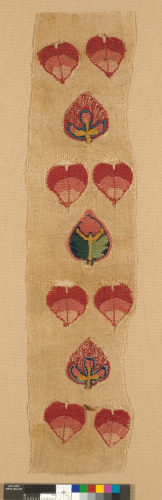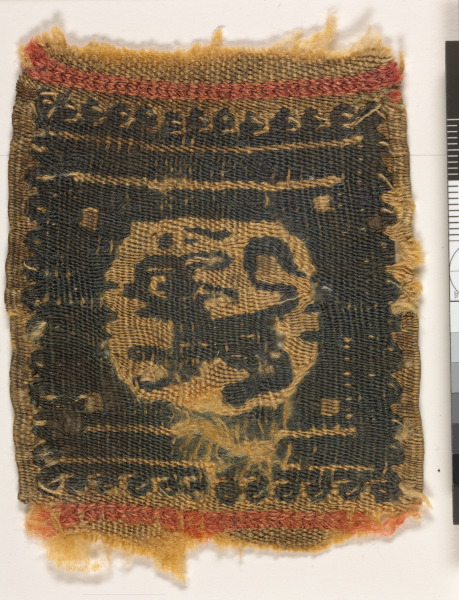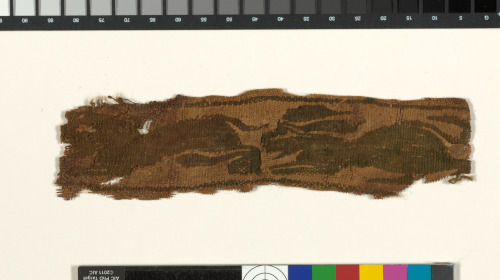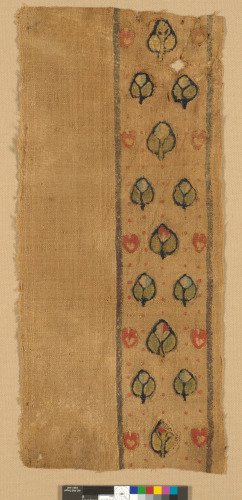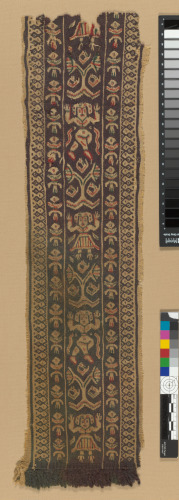
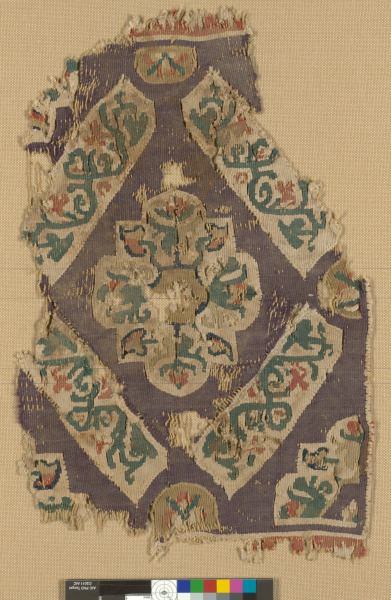
Fragment of a Decorative Band with Floral Medallion in Diamond Grid
Coptic, 301-999
Scroll
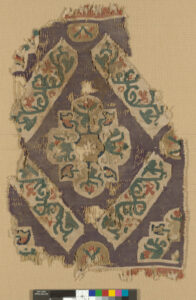
Fragment of a Decorative Band with Floral Medallion in Diamond Grid
Coptic, 301-999
Physical Qualities
Wool, 8 1/2 x 5 3/8 in. (21.6 x 13.7 cm.)
Credit Line
Purchase with exchange funds from Frank J. and Elizabeth L. Goodnow Collection
Object Number
1956.122
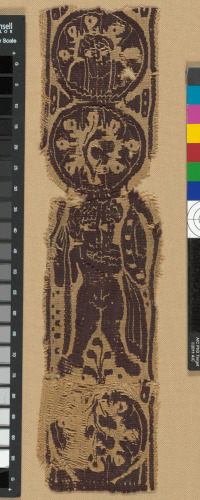
Coptic textiles such as this one may have been used for tunic decoration or may have served some domestic function. The grid design with its lobed rectangular medallion could have been inspired by repeating patterns found in silk textiles from the Near East. The weaving of elaborate polychrome floral vines in tapestry technique on each section of the white grid would have been tedious work, requiring both time and skill to produce even a single unit of the design. Impressed and inspired by the tenacity and ability of her ancient counterparts, [Louise] Wheatley adapts similar patterns and designs in her own weaving. The colored yarns used both for decoration and ground in this textile were created with natural dyes. In ancient times such dyes were often costly. Purple, which came from a shellfish called murex purpureus was especially expensive and substitutes were sometimes used. Here the lighter purple ground may have been produced with a mixture of blue indigo and madder, a red dye produced from the root of a plant of the same name.
The Baltimore Museum of Art by purchase, 1956; E.Hollis Hopkins, Baltimore, MD.
Timeless Weft: Ancient Tapestries and the Art of Louise B. Wheatley
Baginski, Alisa; and Tidhar, Amalia. "Textiles from Egypt 4th-13th Centuries C.E." Jerusalem: L.A. Mayer Memorial Institute for Islamic Art, 1980, p. 51, no. 31, p. 108, no. 150.
DuBourguet, Pierre. "Tissus Coptes." Angers, FR: Musâee des beaux-arts, 1977, no.78.
Rutschowscaya, Marie-Hélène. " Coptic Fabrics." Paris: Editions Adam Biro, 1990, p.17 p.56, p.123.
DuBourguet, Pierre. "Tissus Coptes." Angers, FR: Musâee des beaux-arts, 1977, no.78.
Rutschowscaya, Marie-Hélène. " Coptic Fabrics." Paris: Editions Adam Biro, 1990, p.17 p.56, p.123.