Unknown Artist
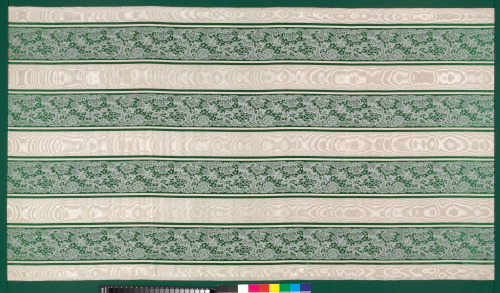
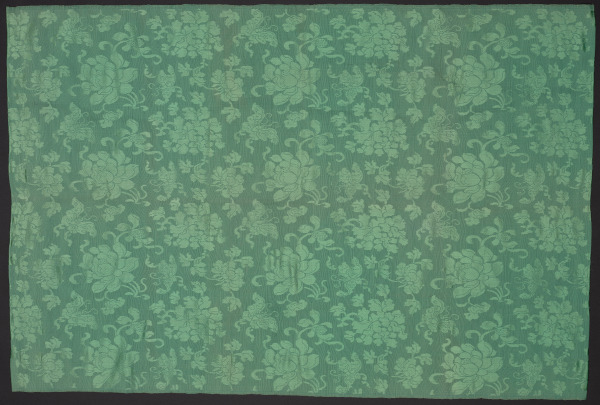
Green Damask Panel with Flowers and Butterflies
1789
Scroll
Unknown Artist
Green Damask Panel with Flowers and Butterflies
1789
Physical Qualities
Silk, 47 × 30 3/4 in. (119.4 × 78.1 cm.)
Credit Line
Gift of John Pearson, Severna Park, Maryland
Object Number
2001.413
Blossoming lotus flowers, peonies, and butterflies float across this silk fabric from China. In the late 1700s, dress and upholstery silks like this one were exported from the international trading port of Canton (present-day Guangzhou), China. Prior to the American Revolutionary War (1775–1783), colonial settlers in Maryland purchased textiles primarily through the British East India Company, an English monopoly that shipped goods between British colonies in Asia, Africa, and the Americas. After gaining independence, the newly formed United States began direct trade with China. The first American-owned ship returned to Baltimore from Canton in 1785. Baltimore City’s Canton neighborhood sits on the property of that ship’s captain, John O’Donnell (1749–1805), an enslaver and merchant who named his plantation after the port.
B. Luberda, Gallery Rotation in Eltonhead Manor, May 31, 2024
Donor obtained the textile from an antique shop in North Situate, Rhode Island, owned by Elizabeth Larsen (Mrs. Arved Larsen) about 20 years ago. Mrs. Larsen claimed the textile was imported into Providence, Rhode Island c. 1790. Larsen wrote a book on printed textiles of Rhode Island and was president of the Roger Williams Society.
American Wing Rotations 2024
Natalie Rothstein, article, Silks for the American Market, Antiques Magazine, October and November, 1967, 90-94 (Oct), 150-156 (Nov). Leanna Lee-Whitman and Maruta Skelton, article, Where Did All The Silver Go?: Identifying Eighteenth-Century Chinese Painted and Printed Silks, The Textile Museum Journal, Vol. 22, 1983, pp. 33-52. Natalie Rothstein, Silks Imported into America in the 18th-Century, an Historical Survey, Symposium: Imported and Domestic Textiles in 18th-century America, April 10-12, 1975. Aileen Ryan Earnest, Trade and Commerce on the Pacific Coast in the 18th-century: A Look at some Chinese Silks of the Mission Period, Symposium: Imported and Domestic Textiles in 18th-century America, April 10-12, 1975. Leanna Lee-Whitman and Maruta Skelton, article, A Systematic Method of Differentiating Between 18th Century Painted-Printed Chinese and Western Silks, Historical Textile and Paper Materials: Conservation and Characterization, Washington, D.C.: American Chemical Society, 1986, pp. 131-151.
Maker
Unknown Artist
2000-01-01 00:00:00–2000-01-01 00:00:00