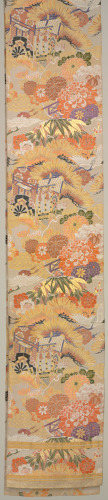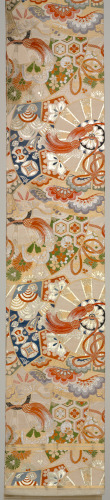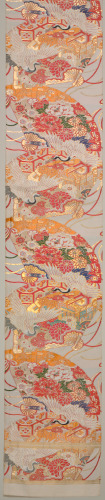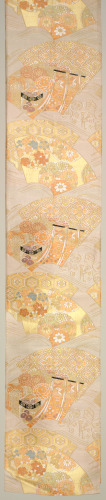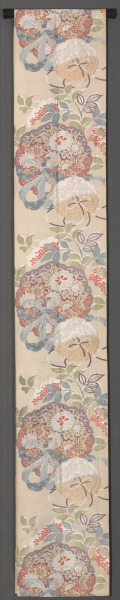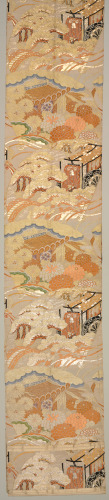
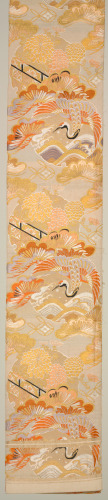
Maru obi featuring crane medallions with pine and chrysanthemum motifs
1911-1939
Scroll
Maru obi featuring crane medallions with pine and chrysanthemum motifs
1911-1939
Physical Qualities
Silk with supplementary wefts of silk, copper and silver metal-leafed paper strips wrapped around silk or cotton thread core, 162-1/2 x 12-3/4 in.
Credit Line
Bequest of Sylvia G. Straton, Rhinebeck, New York
Object Number
2002.684
A long narrow stiff obi [maru obi] composed of one width folded in half of complex-woven nishiki fabric (polychrome figured silk with wefts of silk and metal-leafed paper strips wrapped around a silk or cotton thread core). This obi features repeated large woven snowflake medallions with cranes and wave motifs adjacent to woven snowflake medallions with chrysanthemums and a portion of a bridge. These two medallions are separated by areas filled with pine and shippo-tsunagi (Seven treasures) motifs. These multicolored designs are woven into a cream colored ground. The crane is woven in white, orange, black, rust, and gray silk wefts and light green silk yarns wrapped in copper-metallic gilt paper. The floral designs are in light orange,white, black, and tan silk wefts and green silk wrapped with copper-metallic gilt paper. The wave and feather designs are in white, and copper-metallic wrapped green silk wefts, and silver metallic wrapped white silk threads.
The obi has been opened along the edges. The lining, which would have stiffened the obi, has been removed. The selvage edges, are folded inward approx. 3/4" on both sides.
The Baltimore Museum of Art by bequest , 2002; Sylvia G. Straton, Rhinebeck, New York
Yamanaka, Norio. The Book of Kimono. Tokyo: Kodansha International, 1982, pp. 66-70.
Noma, Seiroki. Japanese Costume and Textile Arts. The Heibonsha Survey of Japanese Art, vol. 16. Tokyo/New York: Weatherhill/ Heibonsha, 1974.
Gluckman, Dale and Takeda, Sharon. When Art Became Fashion: Kosode in Edo-Period Japan. Los Angeles County Museum of Art, 1992, pp. 298-307.
Yang, Sunny and Narasin, Rochelle M. Textile Art of Japan. Tokyo: Shufunotomo Co., Ltd., 1989, pp. 101-109.
Liddell, Jill. The Story of the Kimono. New York: E. P. Dutton, 1989.
Noma, Seiroki. Japanese Costume and Textile Arts. The Heibonsha Survey of Japanese Art, vol. 16. Tokyo/New York: Weatherhill/ Heibonsha, 1974.
Gluckman, Dale and Takeda, Sharon. When Art Became Fashion: Kosode in Edo-Period Japan. Los Angeles County Museum of Art, 1992, pp. 298-307.
Yang, Sunny and Narasin, Rochelle M. Textile Art of Japan. Tokyo: Shufunotomo Co., Ltd., 1989, pp. 101-109.
Liddell, Jill. The Story of the Kimono. New York: E. P. Dutton, 1989.