
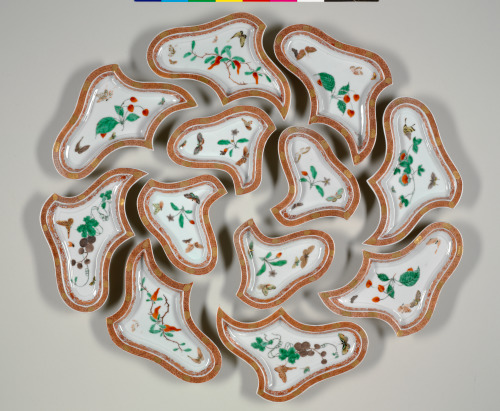
Jingdezhen kilns
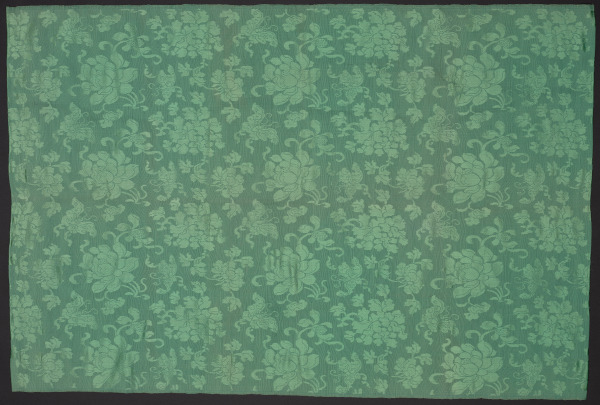
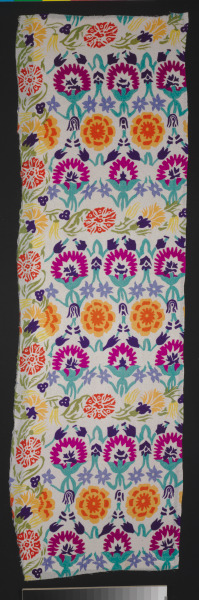
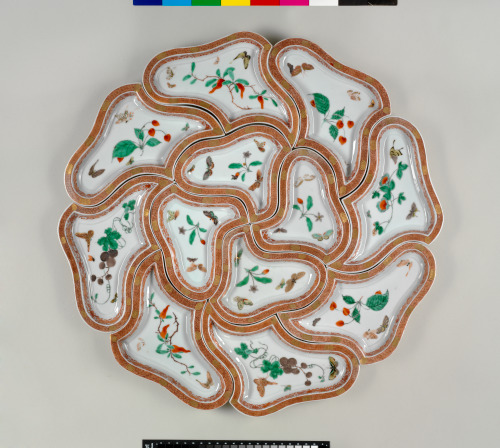
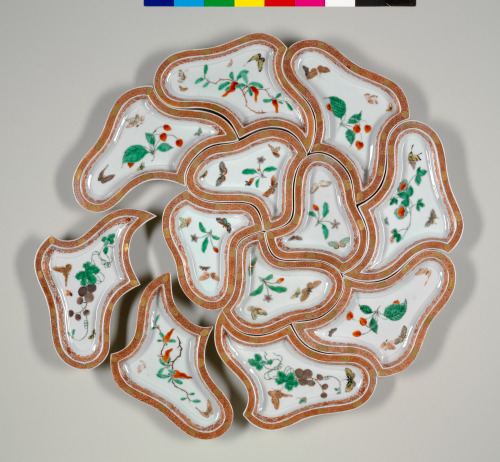
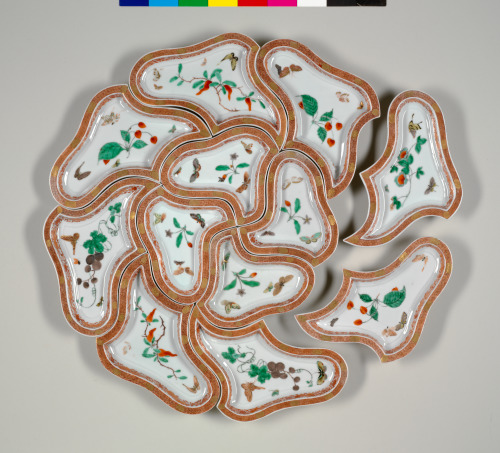
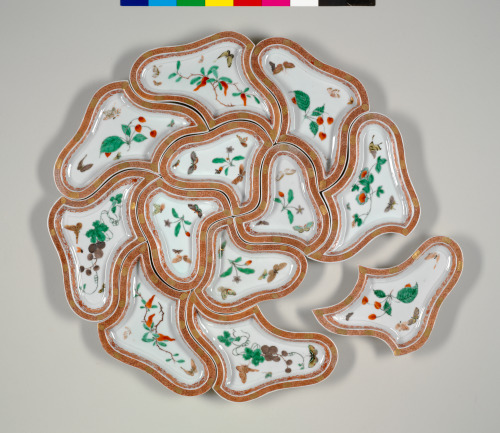
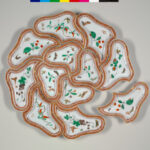
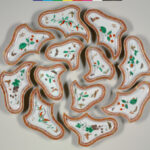
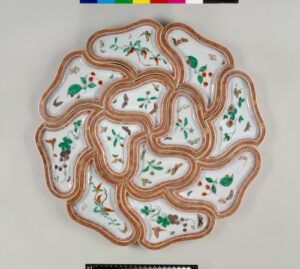
Segmented Plate with Design of Flowers, Fruits, and Butterflies
1705-1711
Scroll
Jingdezhen kilns
Segmented Plate with Design of Flowers, Fruits, and Butterflies
1705-1711
Physical Qualities
Porcelain with overglaze painted enamel (hua falang) and gold decoration, Overall: 1 × 20 1/16 in. (2.6 × 51 cm.)
Credit Line
Gift of Amy Gould and Matthew Polk, Gibson Island, Maryland
Object Number
2014.166
The Kangxi Emperor (1654–1722) took a personal interest in the arts and science and was aware of European technology. After first requesting the presence of French Jesuit missionaries skilled in science and art, the Emperor summoned a German expert to guide the refinement of hua falang (painted enamel) decoration. In 1693, the Kangxi Emperor set up 14 imperial workshops, including an enamel-on-metal workshop. In 1696, a glass factory was added which the Emperor invited Kilian Stumpf (1655–1720), a German Jesuit, to direct. Stumpf Chinese artists in producing glass vessels, preparing enamel colors, and improving the quality of painted enamels on porcelain. His lessons resulted in this plate’s bright, clear, colorful decoration that expresses a wish for longevity.
The Baltimore Museum of Art by gift, 2014; Matthew Polk by purchase, c. 1983; John S. Pearson Company, Baltimore, 1983; Priscilla Ridgely Smith Lyne (d. 1983), Salisbury, MD, 1980; University Museum, Philadelphia, 1972-1980, as an extended loan; from her husband, Henry Lyne, Jr. (1908-1978), Haverford, PA and St. John's, VI, 1959; from his first wife, Ann West Jenks Lyne (1912-1959), 1946; from her father, John Story Jenks (1876-1946)
Asian Reinstallation: Home, Temple, Tomb
Asian Gallery Rotations 2021
[Asian Refresh]
Asian Gallery Rotations 2022
Asian Gallery Rotations 2023
Asian Rotations 2024
Asian Rotations 2025
"Kangxi-Yongzheng-Qianlong. Qing Porcelain from the Palace Museum," Beijing: Gugong Museum, 1989, p. 46, for a nearly identical flower-form segmented plate.
The Complete Collection of Treasures in the Palace Museum. Porcelains in Polychrome and Contrasting Colours, Hong Kong, 1999, pl. 96
The Official Kiln Porcelain of the Chinese Qing Dynasty, Shanghai Museum, Shanghai, 2003, cat. no. 66 ("another set, but lacking the iron-red scroll on the well of each dish, in the Nanjing Museum")
"The Secret of Colours: Ceramics in China and Europe from the 18th Century to the Present," Orientations, September/October 2022.
The Complete Collection of Treasures in the Palace Museum. Porcelains in Polychrome and Contrasting Colours, Hong Kong, 1999, pl. 96
The Official Kiln Porcelain of the Chinese Qing Dynasty, Shanghai Museum, Shanghai, 2003, cat. no. 66 ("another set, but lacking the iron-red scroll on the well of each dish, in the Nanjing Museum")
"The Secret of Colours: Ceramics in China and Europe from the 18th Century to the Present," Orientations, September/October 2022.
Inscribed: None. Ink on adhesive labels, bottom of several dishes, "John S. Jenks", "L-738-80" and "L-738-91"
Markings: None.
 On View at the BMA