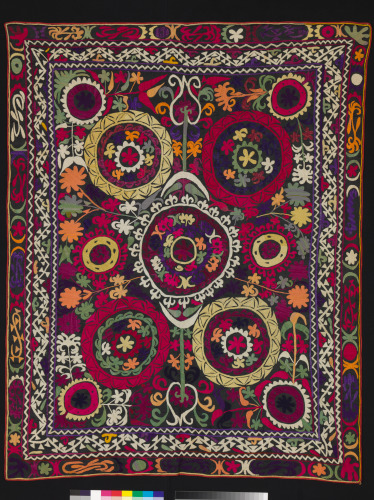
Small Embroidered Hanging or Cover (nimsuzani or borpush)
1865-1949
Scroll
Small Embroidered Hanging or Cover (nimsuzani or borpush)
1865-1949
Physical Qualities
Cotton ground, silk embroidery threads, cotton backing, 68 1/2 x 54 1/4 in. (174 x 137.8 cm.)
Credit Line
Gift of Jerry Maizlish, Sparks, Maryland
Object Number
1991.451
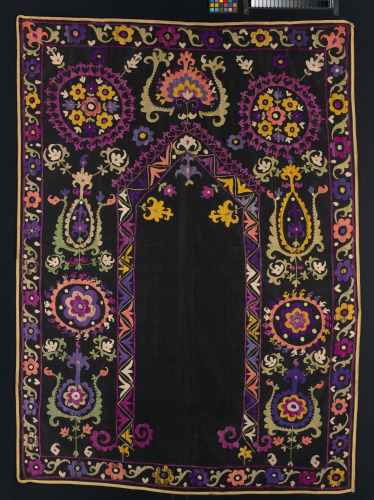
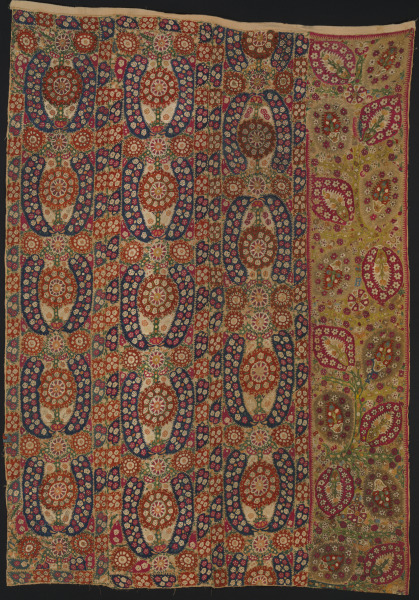
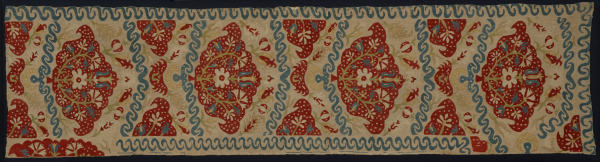
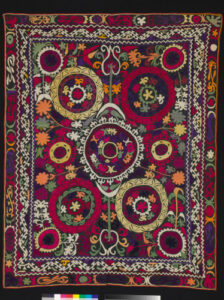
The Tajiks and many other people of Central Asia derive from Persian-speaking cultures of Iran. This unusual nimsuzani or borpush, used as a hanging or cover, appears to be related to Persian textiles. The central rosette and surrounding smaller rosettes with rings of embroidery emphasize the circle, an archaic motif probably referring to the sun. The crescent shapes beneath the pomegranate motifs may speak to moon imagery. Cartouches within the outside border contain abstract designs reminiscent of the inscriptions found in Persian rugs and Islamic embroideries and silks.
Earlier suzani were often worked on homespun white cotton. In the 19th century, commercially woven cotton fabric from Russia became available and was commonly used for suzani. Motifs are worked in multiple colors of silk threads using a combination of laid and couched stitches. Long strands are first laid across the fabric surface. Then these strands are secured with short couching stitches aligned diagonally.
Baltimore Museum of Art by gift, 1991; Gerald (Jerry) Maizlish by purchase, c. 1973 Sparks, MD; Afghanistan.
Embroidered Treasures: Textiles from Central Asia
Andre, Linda, and Jessica Skwire Routhier, eds. The Baltimore Museum of Art: Celebrating A Museum. Baltimore, Maryland: Baltimore Museum of Art, 2014, ill. p. 125.
BMA Today, Fall, 2011. Article announcing the opening exhibition: Embroidered Treasures: Textiles from Central Asia featured a detail of the Borpush or Nimsuzani.
Bacon, Elizabeth E. Central Asians Under Russian Rule, Ithaca, New York: Cornell University Press, 1980 reprint of a 1966 edition, p. 15, pp. 17-19, map facing p. 18.
Cootner,Cathryn M. “Gardens of Paradise”, and Daniel Shaffer, “History & Technique”, in “Suzani,” Hali Magazine (April/May/June 1986), pp. 44-51.
Franses, Michael and Robert Pinner, “Large Medallion Suzani from Southwest Uzbekistan”, Hali Magazine, Vol. 1, No. 2, Summer 1978, pp. 128-133.
Knorr, Thomas and David Lindahl, Uzbek: The Textiles & Life of the Nomadic and Sedentary Uzbek Tribes of Central Asia, Basel, Switzerland: Zhinden Druck und Verlag AG, 1975.
Levinsteyn,Y. “Unravelling Central Asian Embroidery”. Hali Magazine, Vol. 4, No. 2, 1981, pp. 152-153.
Paine, Sheila. Embroidered Textiles: Traditional Patterns from Five Continents, New York: Rizzoli, 1990, p. 26, pp. 108-109.
Tent & Town: Rugs & Embroideries from Central Asia: The H. McCoy Jones Collection, San Francisco: The Fine Art Museum of San Francisco, M. H. DeYoung Memorial.
Baker, Patricia L.. "9: The Contemporary World." In Islamic textiles. London: British Museum Press, 1995. 163-167.
Djumaev, Koriogdi. "Lively colors of Bukhara's suzaneh." San'at Art. Web. 22 July 2011. <http://www.sanat.orexca.com/eng/4-03/history_art8.shtml>.
"The Bewitching Embroidered Masterpieces." Embassy of the Republic of Uzbekistan to the Islamic Republic of Pakistan. 7 July 2011. Web. Accessed 19 July 2011. <http://uzbelembassypakistan.org/index.php?q=content/bewitching-embroidered-masterpieces>.
Franses, Michael. “Flower Power.” In Hali Magazine, Issue 115: 93-97.
"Cover [Uzbekistan] (21.114.3)." The Metropolitan Museum of Art. Web. 6 July 2011. <http://metmuseum.org/toah/works-of-art/21.114.3>.
Gilfoy, Peggy Stoltz. Fabrics in celebration from the collection. Indianapolis, Ind.: The Indianpolis Museum of Art, 1983. 44, 130.
"40. A large medallion Suzani embroidery, Uzbekistan." Sotheby's: Fine Oriental and European Carpets including Property from the Collection of Aram K. Jerrehian 27 Apr. 2000: 21.
Staples, Loretta N.. A sense of pattern: textile masterworks from the Yale University Art Gallery, May 14-September 13, 1981. New Haven, Conn.: Yale University Art Gallery , 1981. 37.
"The Collection: 2004.259.13 Suzani." Minneapolis Institute of Arts. Web. 27 June 2011. <https://collections.artsmia.org/index.php?page=detail&id=96367>.
"The Collection: 99.245.66 Suzani." Minneapolis Institute of Arts. Web. 27 June 2011. https://collections.artsmia.org/index.php?page=detail&id=32327
"The Collection: 2004.259.12 Suzani." Minneapolis Institute of Arts. Web. 27 June 2011. <https://collections.artsmia.org/index.php?page=detail&id=96366>.
Cootner,Cathryn M. “Gardens of Paradise”, and Daniel Shaffer, “History & Technique”, in “Suzani,” Hali Magazine (April/May/June 1986), pp. 44-51.
Franses, Michael and Robert Pinner, “Large Medallion Suzani from Southwest Uzbekistan”, Hali Magazine, Vol. 1, No. 2, Summer 1978, pp. 128-133.
Knorr, Thomas and David Lindahl, Uzbek: The Textiles & Life of the Nomadic and Sedentary Uzbek Tribes of Central Asia, Basel, Switzerland: Zhinden Druck und Verlag AG, 1975.
Levinsteyn,Y. “Unravelling Central Asian Embroidery”. Hali Magazine, Vol. 4, No. 2, 1981, pp. 152-153.
Paine, Sheila. Embroidered Textiles: Traditional Patterns from Five Continents, New York: Rizzoli, 1990, p. 26, pp. 108-109.
Tent & Town: Rugs & Embroideries from Central Asia: The H. McCoy Jones Collection, San Francisco: The Fine Art Museum of San Francisco, M. H. DeYoung Memorial.
Baker, Patricia L.. "9: The Contemporary World." In Islamic textiles. London: British Museum Press, 1995. 163-167.
Djumaev, Koriogdi. "Lively colors of Bukhara's suzaneh." San'at Art. Web. 22 July 2011. <http://www.sanat.orexca.com/eng/4-03/history_art8.shtml>.
"The Bewitching Embroidered Masterpieces." Embassy of the Republic of Uzbekistan to the Islamic Republic of Pakistan. 7 July 2011. Web. Accessed 19 July 2011. <http://uzbelembassypakistan.org/index.php?q=content/bewitching-embroidered-masterpieces>.
Franses, Michael. “Flower Power.” In Hali Magazine, Issue 115: 93-97.
"Cover [Uzbekistan] (21.114.3)." The Metropolitan Museum of Art. Web. 6 July 2011. <http://metmuseum.org/toah/works-of-art/21.114.3>.
Gilfoy, Peggy Stoltz. Fabrics in celebration from the collection. Indianapolis, Ind.: The Indianpolis Museum of Art, 1983. 44, 130.
"40. A large medallion Suzani embroidery, Uzbekistan." Sotheby's: Fine Oriental and European Carpets including Property from the Collection of Aram K. Jerrehian 27 Apr. 2000: 21.
Staples, Loretta N.. A sense of pattern: textile masterworks from the Yale University Art Gallery, May 14-September 13, 1981. New Haven, Conn.: Yale University Art Gallery , 1981. 37.
"The Collection: 2004.259.13 Suzani." Minneapolis Institute of Arts. Web. 27 June 2011. <https://collections.artsmia.org/index.php?page=detail&id=96367>.
"The Collection: 99.245.66 Suzani." Minneapolis Institute of Arts. Web. 27 June 2011. https://collections.artsmia.org/index.php?page=detail&id=32327
"The Collection: 2004.259.12 Suzani." Minneapolis Institute of Arts. Web. 27 June 2011. <https://collections.artsmia.org/index.php?page=detail&id=96366>.
Inscribed: Written in ink on a square of adhesive cloth tape(?) approximately 1/2' square located on the reverse side, at the lower left corner: '41'