
Margaret Bourke-White
The Top Strata of Life in Muncie, Indiana
1936
Scroll
Margaret Bourke-White
The Top Strata of Life in Muncie, Indiana
1936
Physical Qualities
Gelatin silver print, Sheet: 350 x 275 mm. (13 3/4 x 10 13/16 in.)
Image: 340 x 255 mm. (13 3/8 x 10 1/16 in.)
Credit Line
Gift of Life Magazine, 1938
Object Number
1977.29.11
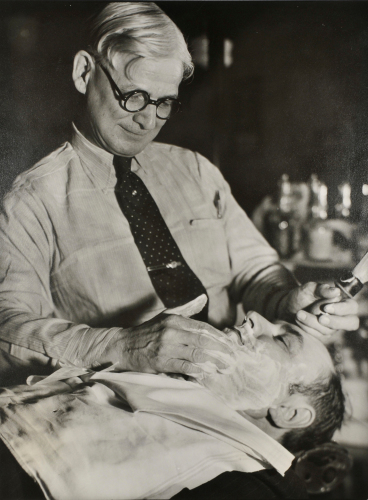
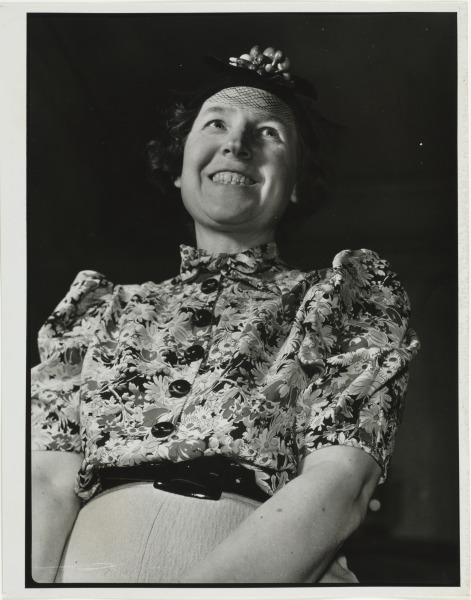
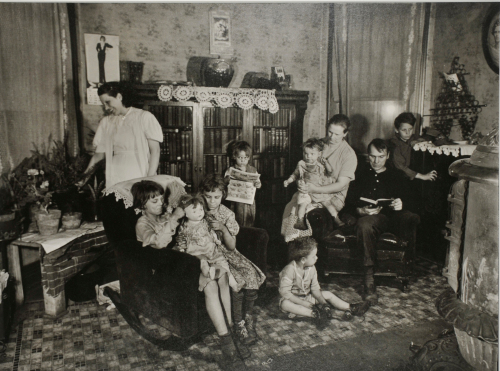
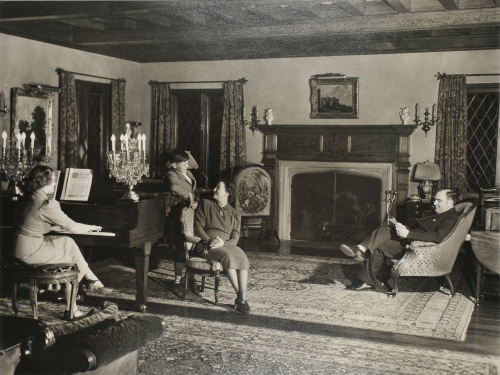
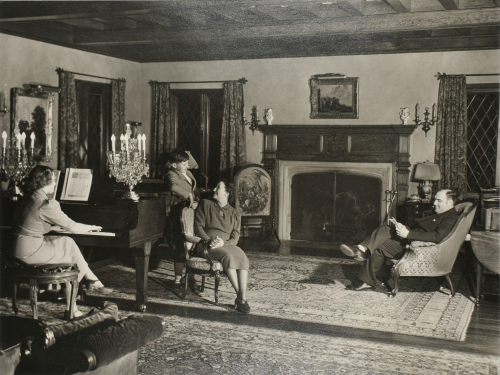
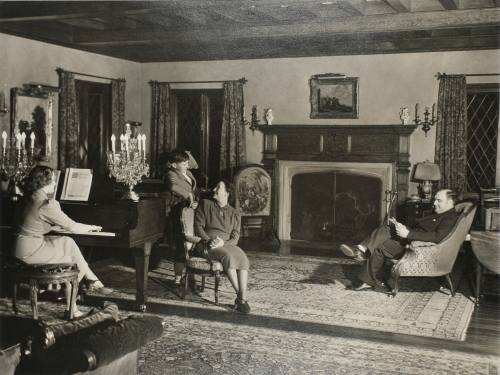
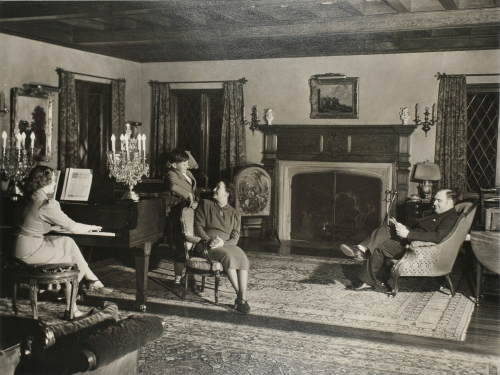
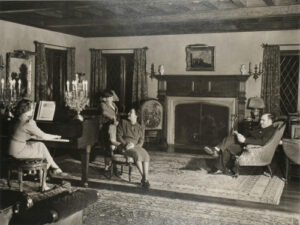
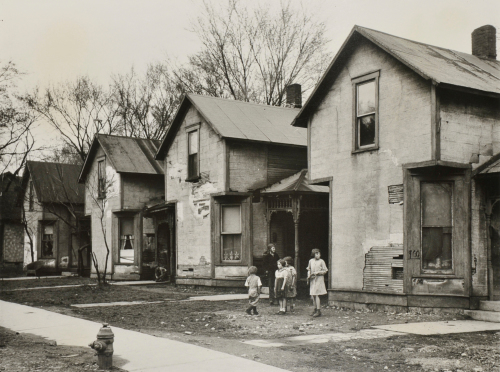
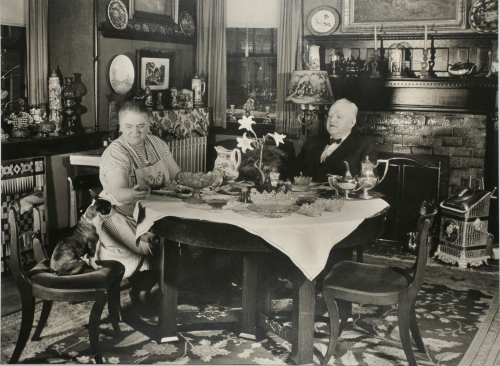
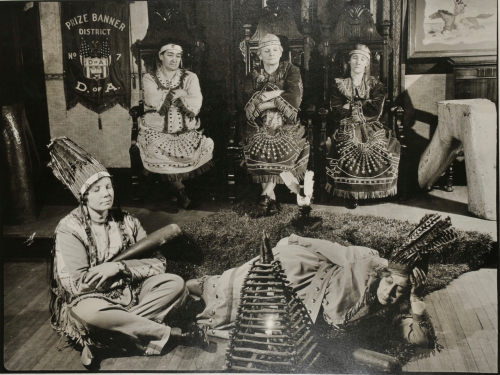
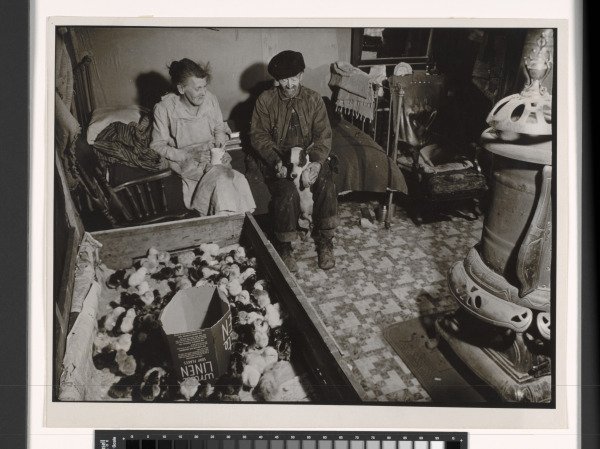
The most arresting—and for Muncie residents, most controversial—part of the “Middletown-Muncie” photo essay is the two-page spread showing four interiors in which families of different financial means pursue their everyday activities. (A copy of this issue of Life, open to this photo spread, can be found in the nearby case.) Beginning at upper left and proceeding counterclockwise, we see Mayor Rollin H. Bunch, still a practicing doctor, and Mrs. Bunch, a cook and farmer, both of whom are passionate about collecting glassware and other American artifacts; together “their hobbies give the home the appearance of a cozy little museum.” Living with his large family in a rented house, the one-legged William H. Hahn, a former Ball jar and steel worker receiving government assistance, spends his time reading Spencer, Darwin, Marx, and the Bible, as well as The Power of Will and Power for Success. More dramatic is the marked contrast between the exemplars of the “top” and “bottom” tiers of Muncie society. Unlike the family of William H. Ball (the son of one of the founders of “Muncie’s dominant glassworks”), who are depicted pursuing “certain leisure activities. . .as a symbol of status”
in their elegant and spacious living room, Scott and Lizabelle Brandenberg live in a filthy shack covered with paper cartons, complete with a “homemade brooder” to raise “chickens ‘fer eatin.’” Taken together, these photographs offer a compelling taxonomy of Muncie’s upper, middle, and lower classes. Muncie’s residents, however, objected to being represented in this way.
Looking through the Lens: Photography 1900-1960
Picturing America 1930-1960: Photographs from The Baltimore Museum of Art
"Middletown-Muncie [Muncie, Indiana]," Life, Vol. 2, No. 19, May 10, 1937, pp. 15-25
Inscribed: Verso: at upper right, in graphite: #140-1 / 5 [5 circled]"; at center, in graphite: "Photo by / Margaret Bourke-White"; at left, in graphite: "5.10.37 Muncie"
Markings: Verso: at left, stamped in red ink: "LIFE"
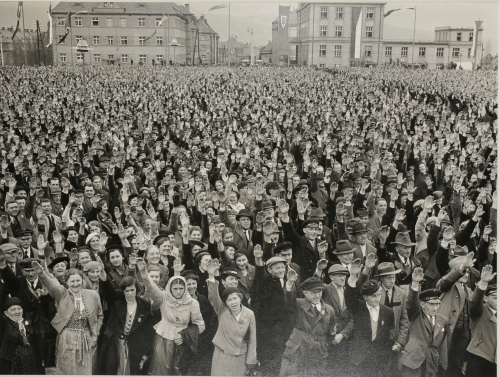
![CZECHOSLOVAKIAN FASCIST HENLEIN SPEAKS TO THE PEOPLE. [PUBLISHED IN 'NORTH OF THE DANUBE,' 1939?]](https://artbmadevsite.org/wp-content/uploads/2026/02/3992_25002653-3.jpg)