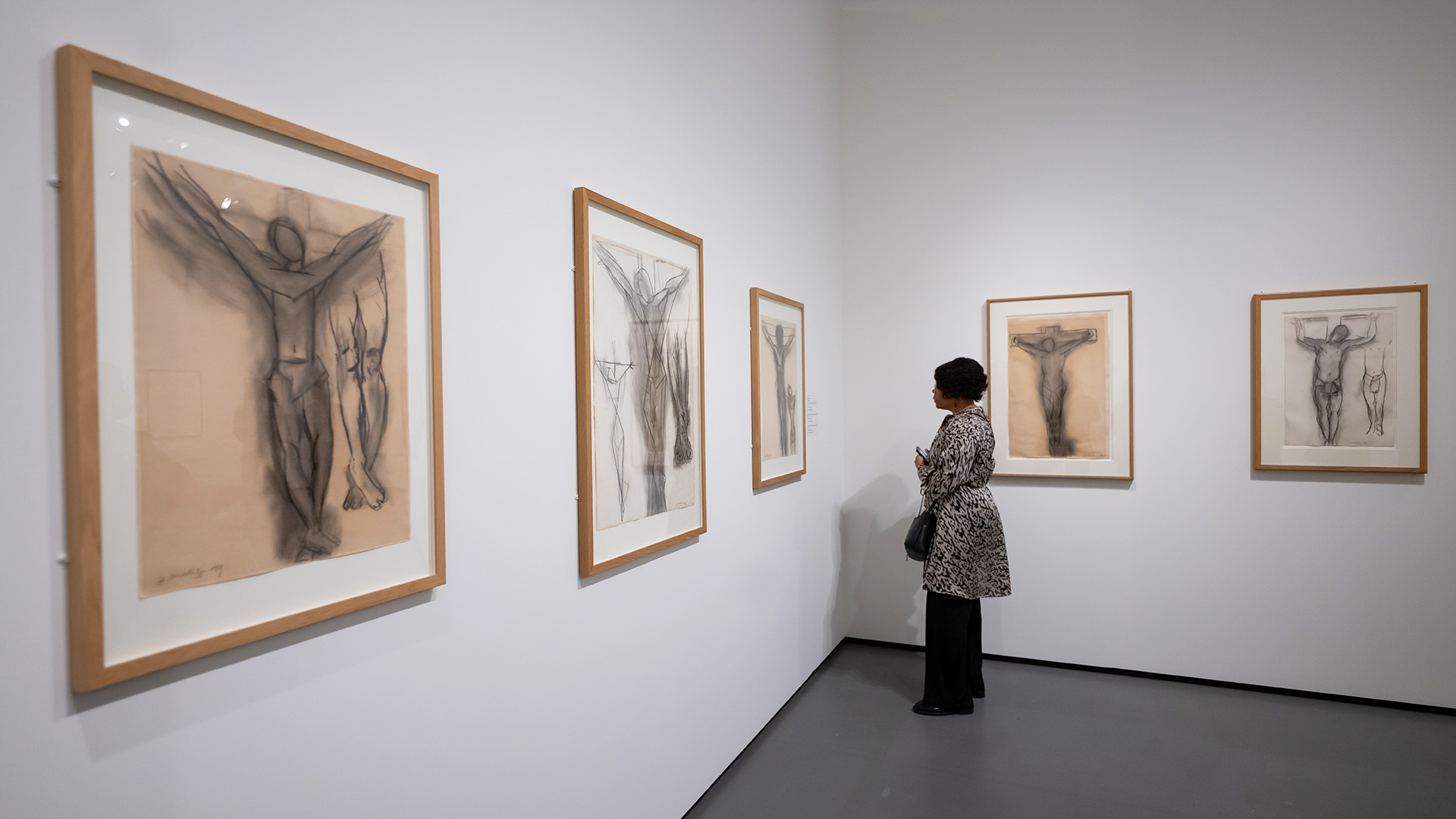




On view from March 29 through June 28, 2026, Matisse in Vence: The Stations of the Cross explores the drawings for a stunning mural in Matisse’s only large-scale architectural project. Here, distinguished Matisse scholar and guest curator Yve-Alain Bois discusses this momentous achievement.
Many visitors to the BMA’s exhibition will be learning about the Chapelle du Rosaire (Chapel of the Rosary) for the first time. Can you tell us more about how Matisse came to be involved in this project?
Serendipity played a big role—the stars were aligned. First, ever since he had made his Dance mural for the Barnes Foundation in Pennsylvania, Matisse had dreamed on working at the architectural scale. Second, a young apprentice–nun (soon to take the name of Sister Jacques-Marie), who had been his nurse and model several years prior, came to see him from a neighboring convent and talked about the desire of her nearby community for a new chapel instead of the damp garage they were using. She showed him a sketch she had made for a stained-glass window that Matisse found touching but … wanting. Third, a young Dominican, Brother Rayssiguier, who dabbled in architecture, came to visit Matisse soon afterward and got him excited about such a project. Five days after their first encounter, the two of them were already drafting plans and discussing the placement of murals and stained-glass windows. Rayssiguier became his main collaborator on the chapel and Sister Jacques-Marie the liaison with the Catholic authorities, who were hostile at first. She deployed a phenomenal amount of energy, and lots of tact, to convince them.
What drew you to the mural depicting the Stations of the Cross and its preparatory drawings?
I have always been intrigued by this mural, for it contradicts so much—not only the rest of the chapel, which is so joyful, but also many aspects of Matisse’s aesthetics in general. He was always against telling a story in painting, always said that a painting must be seen as a whole and not bit by bit, did not like to paint violence or suffering, found that any image based on a text was bound to fail—not to mention the fact that he knew next to nothing about Christian imagery, etc. There were so many reasons why he would be the least-qualified artist to tackle the theme of the Stations of the Cross!
A mural representing Saint Dominic and another of the Virgin and Child make a lot of sense in a chapel dedicated to the rosary (it was the real Saint Dominic who initiated the ritual of the rosary), but for a third mural, why not, say, paradise? That would have been a lot more in tone with the rest of the chapel than this brooding, halting rendition of the Stations of the Cross. Not to speak of the decision—without much historical precedent—of grouping the 14 Stations on a single panel rather than having them on separated panels aligned on the wall, as is the custom. And then there is the style in which this composition is executed, which Matisse himself called “graffiti” and of which he said it was so “rude” that it would shock whoever sees it.
Yet another thing that intrigued me is that Matisse made more sketches for this mural than for any other composition in his entire life, and some of those sketches count, for me, among his best drawings—I’d even say, for two of them, among his ten best ever.
In short, I have always been struck by Matisse’s Stations of theCross mural and for years have read whatever was written on it. All I found were small pickings, which were not really up to the task, so I decided to go at it myself.
During your time curating this exhibition, has there been something about Matisse’s practice or style that has surprised or delighted you?
Not really. Even the more bizarre things, such as having a model posing in a loin cloth and suspended by ropes from a wooden cross in his studio (in order to draw the Crucifixion) were aligned with the rest of his practice.
What do you hope visitors take away from the show?
The same message that Matisse wanted most to convey during the last decade of his life (he insisted on this on many occasions, for example with his 1943 book of drawings titled Themes and variations, or in his now famous letter to the director of the Philadelphia Museum of Art, published in the catalog of his retrospective there in 1948): that it takes a lot of work and effort to make something that looks as simple as his mural.

Matisse in Vence: The Stations of the Cross is co-produced by the Musée Matisse Nice and the Baltimore Museum of Art. This exhibition was presented at the Musée Matisse Nice from October 1, 2025, to January 19, 2026. This exhibition is guest curated by Yve-Alain Bois, Professor Emeritus, Institute for Advanced Study, Princeton, with assistance from Alix Agret, art historian and researcher. The BMA presentation is supported curatorially by Katy Rothkopf, the Anne and Ben Cone Memorial Director of the Ruth R. Marder Center for Matisse Studies and Senior Curator of European Painting and Sculpture.
The BMA presentation is supported by Nancy Dorman and Stanley Mazaroff, The Pierre and Tana Matisse Foundation, and the Estate of Carolyn Lee Smith.
The audio guide is made possible with support from the Lilly Endowment Inc.