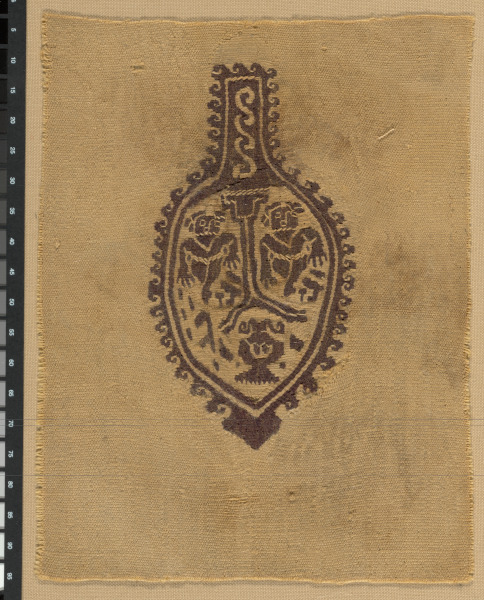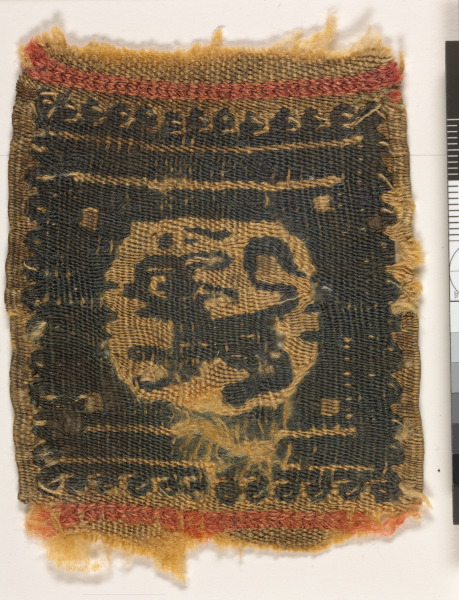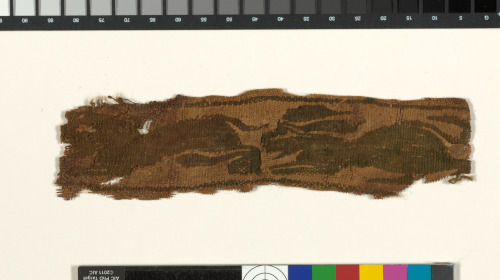

Coptic
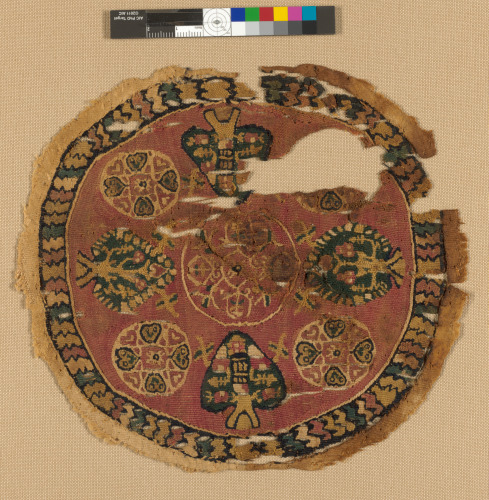
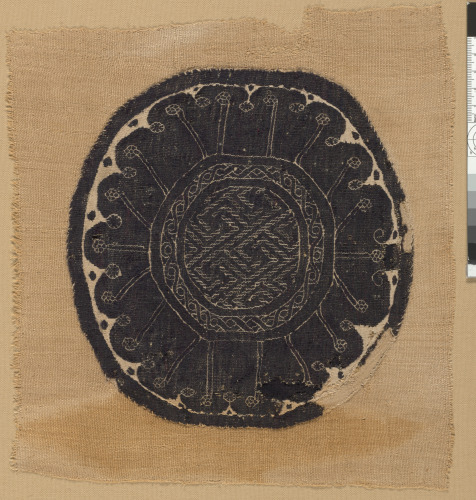
Roundel (Orbiculus) with Fret Designs and Scalloped Border
Coptic, 301-500
Scroll
Coptic
Roundel (Orbiculus) with Fret Designs and Scalloped Border
Coptic, 301-500
Physical Qualities
Wool, linen, 11 x 10 in. (27.9 x 25.4 cm.)
Credit Line
Gift of Dena S. Katzenberg, Baltimore
Object Number
1985.222
Elaborate geometric fret designs often appeared in roundels (orbiculi), clavi, and other tunic ornaments and domestic textiles. The technique used is often referred to as embroidery. However, it is actually weaving in which the weft is wrapped around warps incrementally or moved in any direction needed to create the design. This is sometimes referred to as “flying shuttle” or “flying needle” technique.
Baltimore Museum of Art by gift 1985; Dena S. Katzenberg, Baltimore, MD.
Timeless Weft: Ancient Tapestries and the Art of Louise B. Wheatley
Katzenberg, Dena S.. "Blue Traditions: Indigo Dyed Textiles and Related Cobalt Glazed Ceramics from the 17th through the 19th Century". Baltimore: Baltimore Museum of Art, 1973. cat. 11, p. 121, p. 48 (ill.).
Carroll, Diane Lee. Looms and Textiles of the Copts: First Millennium Egyptian Textiles in the Carl Austin Rietz Collection of the California Academy of Sciences. San Francisco: California Academy of Sciences, 1988, cat.# 3. "Oval Dress Ornament," pp. 84-85, illus..
Erikson, Marianne. Textiles in Egypt 200-1500 A. D. in Swedish Museum Collections. Göteborg, Sweden: Röhsska Museet [Gothenburg, Sweden: Röhss Museum of Applied Art and Design], 1998 pp. 77-83, illus. p. 80.
Erikson, Marianne. Textiles in Egypt 200-1500 A. D. in Swedish Museum Collections. Göteborg, Sweden: Röhsska Museet [Gothenburg, Sweden: Röhss Museum of Applied Art and Design], 1998 pp. 77-83, illus. p. 80.