Coptic
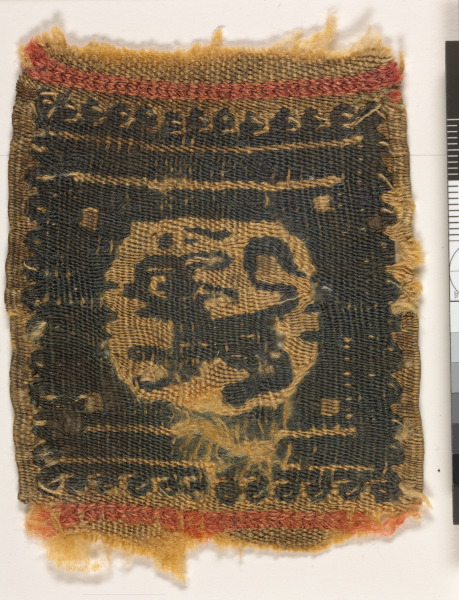
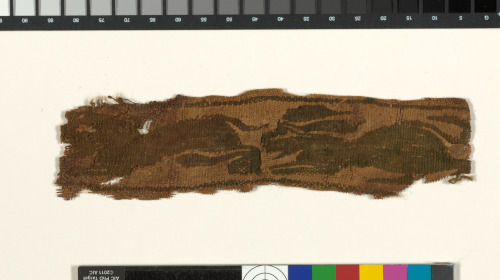
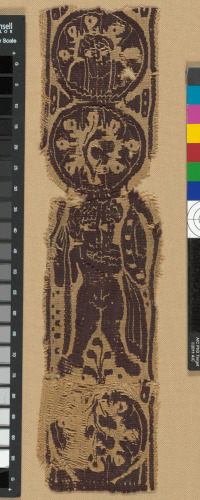
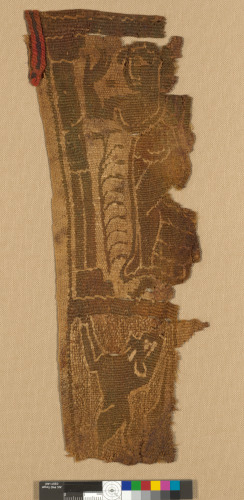
Fragment of Tunic Ornament with Dancing Woman (Bacchante) and Animal
Coptic, 501-600
Scroll
Coptic
Fragment of Tunic Ornament with Dancing Woman (Bacchante) and Animal
Coptic, 501-600
Physical Qualities
Wool, linen, 9 3/8 × 3 3/8 in. (23.8 × 8.6 cm.)
Credit Line
Gift of Kenneth S. Battye, Baltimore
Object Number
1986.278
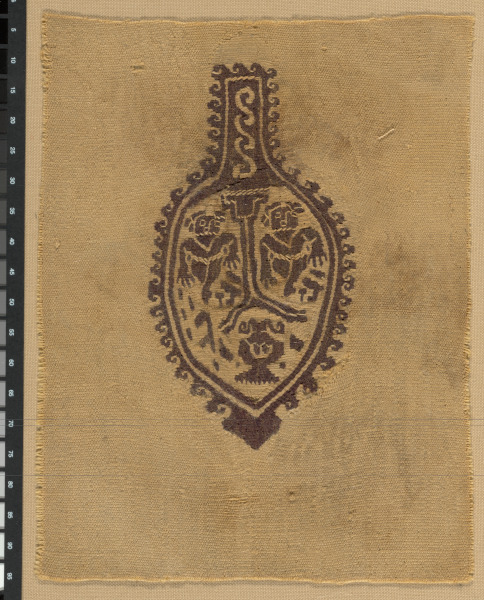
Coptic textiles reflect multiple cultural and weaving traditions, as well as Roman tunic design. Generally, plain-woven linen formed the ground weave of the majority of the garment. Tapestry-woven inserts of wool (or wool and linen) were added for decoration. The tapestry-woven areas are often composed of figural designs, representing dancers, shepherds, hunters, and deities, depicted within architectural frameworks and/or combined with stylized animals and floral motifs. Many inserts, such as this fragment, were woven in silhouette style in which figures were depicted using dark purple wefts (now turned brown) on the warps of a natural ground fabric. Here a figure with an upraised arm, probably a Bacchante or a follower of the Greek divinity Dionysus, stands within a space supported by a column. This fragment could have been part of a vertical strip (clavus) or a horizontal row of similar figures across the front of a tunic.
Baltimore Museum of Art by gift, 1985; Kenneth S. Battye by purchase, Baltimore, MD; Phyllis C. Kane by purchase, Washington, D.C; Private Collection, Rome, Italy.
Timeless Weft: Ancient Tapestries and the Art of Louise B. Wheatley